
Pizza Marumo, in Ebisu, Tokyo

As we work to create this “short list” of amazing pizza in Tokyo, we worked our way into Pizza Marumo in Ebisu, Tokyo. It was not easy to get a seat, so it took a while, but… it was worth it; I know a good bite when I taste it. Read on to find out why Tokyo’s Pizza Marumo makes one of the best pizzas you will ever have.
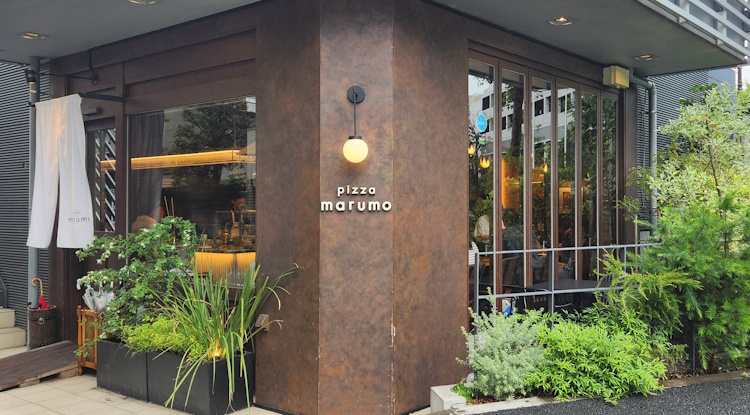
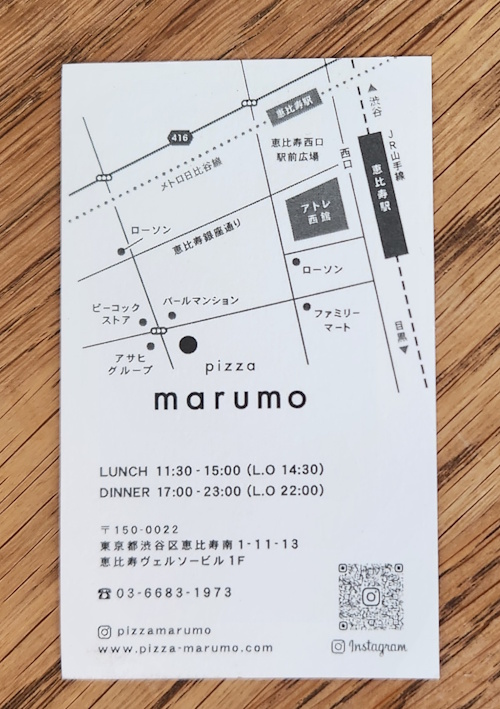
For your first visit to Marumo Pizza in Ebisu (reservations are highly recommended), there is a good chance you’ll start off at the Ebisu Station. From there, it is less than a 10 minute walk up the hill and through the neighborhood to the restaurant.
(On your way, you might take note of Bar Martha – which is another story, but may also be worthy of your attention.)
As I walked in the door, I immediately had a sense that the level of service at Marumo was on another level. The service had that “five star feeling” you might get in first class, or at good department stores (yes, I am thinking of Nordstrom), or from high-end financial service; the staff look you in the eyes, they are attentive, there is care in the way they interact with customers. Every moment I was in the shop, I felt catered to – which isn’t necessary for me, but it was easy to appreciate.
I will confess; because it was so difficult to get a reservation (and even four weeks in advance I could only get a seat for one, at lunch, at 1:30 PM), I had a chip on my shoulder – I expected the food to be very good, but I also presumed pretense, and I expected not to enjoy the experience very much. But before I could even sit down, I felt relaxed, and curious, and the best part was yet to come.
Let’s talk about the pizza.
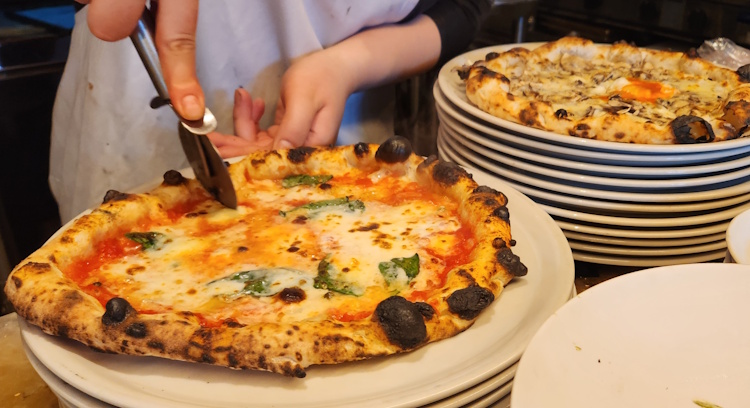
From the pictures of Pizza Marumo in Tokyo in this review you can see they make Neapolitan-style pizza. You certainly could order the “standard margherita,” it’s on the menu, but I would not do that.
The Marumo Pizza Menu is extensive, a big, two-page spread of pizzas, in six categories, which include tomato-based pizzas, creamy white pizzas, mayo-based pizzas (no thank you), cheese base (no tomato sauce), “Vegan” pizzas, and sweet “Dolce” pizzas. Not only should you expect a very high-quality pizza, but Pizza Marumo also offer creative array of choices, some truly imaginative pizzas that never err into anything “gimmicky” or overtly-novel.
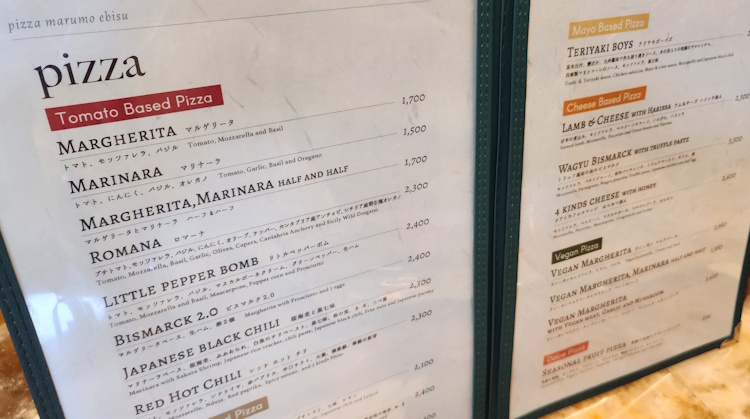
The tomato-based pizzas do include classics like the margarita, marinara, and then more original pizzas like the Little Pepper Bomb pizza and the Red Hot Chili pizza. One of the cream-based pizzas was a staff-recommended favorite called the Japanese Umami pizza:
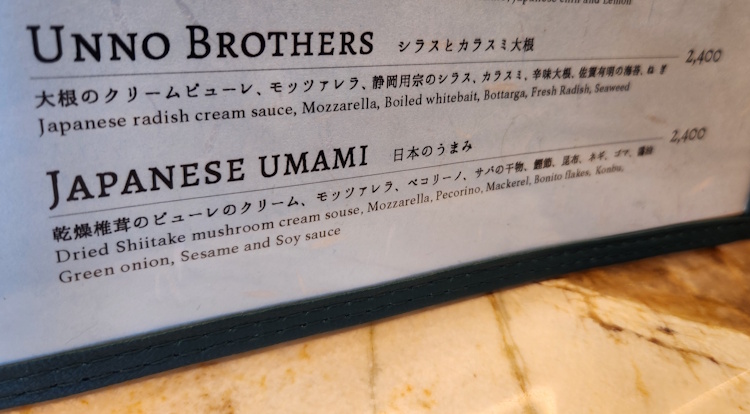
“Pizza Marumo Japanese Umami Pizza: Dried shiitake mushroom cream sauce, Mozzarella, Pecorino, Mackerel, Benito flakes, Konbu, Green onion, Sesame and Soy sauce.”
Doesn’t that sound amazing? How could you order an margherita when you could try a pizza that extraordinary? I am astounded I didn’t order this pizza myself – and I will most definitely order this one next time – but for this occasion I had another of their pizzas in my sights.
Let’s talk about that Japanese Black Chili pizza. While so many pizzas on that menu caught my eye, this black chili option was unavoidably tempting:
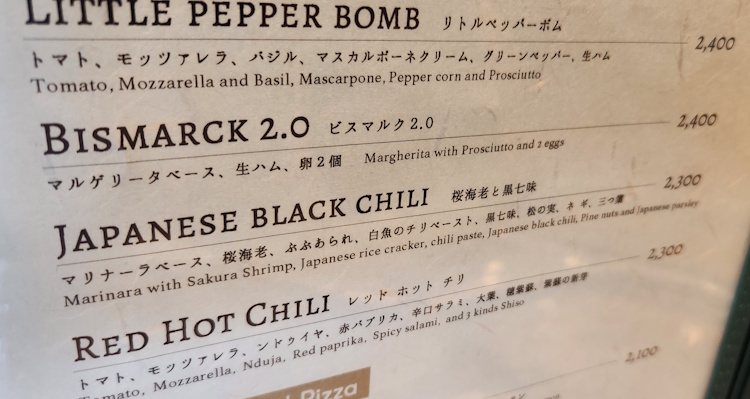
“Pizza Marumo Japanese Black Chili Pizza: Marinara with Sakura Shrimp, Japanese rice cracker, Chili paste, Japanese black chiki, Pine nuts, and Japanese parsley.”
The description of the Japanese Black Chili pizza at Marumo was like nothing I had ever seen before. It was unique, certainly. It was also a distinctly “Asian” pizza, and that sounded like a opportunity for Marumo to take Tokyo pizza in a new direction.
I wanted to try it.
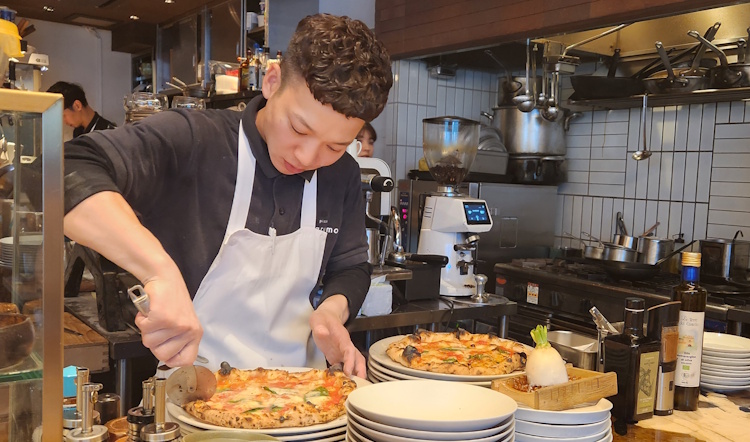
Watching the pizza wizard assemble the Black Chili pizza helps you see how they are doing something at Marumo that just isn’t available at other pizza places in Tokyo.
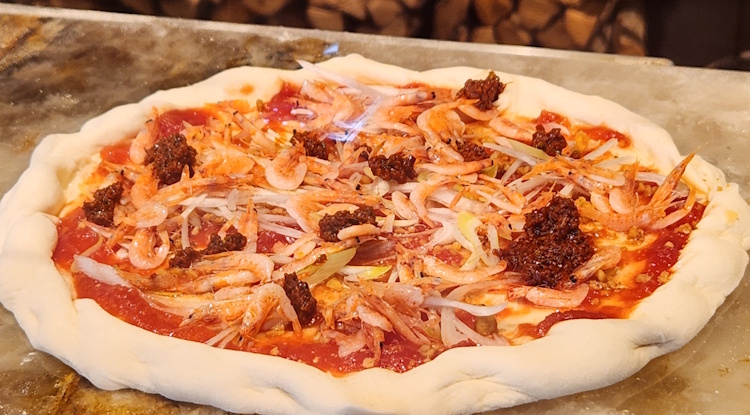
The Japanese Black Chili Pizza comes together in stages: The dough, shaped and spread. The red sauce (at times spelled “souse” on the menu). Some razor-thin green onions. The tiny, pink “sakura” shrimp. Dabs of red chili paste. Shaved garlic. Olive oil from a brass spout. Fast-fired in the oven, then onto post-production; the tiny crunchy rice cracker balls, then green, leafy Japanese parsley, and sprinkles of secret spices.
As it came out of the oven, first bite: Crunchy. Then, the seafood-shrimp taste. Then a mild burn along with that deep spicy flavor.
Wow.
Each bite brought an opportunity to appreciate a layer. At one moment, the parsley was so light, bitter, refreshing. The next, ouuu – garlic. Then, “ahhh… there are pine nuts on this pizza.”
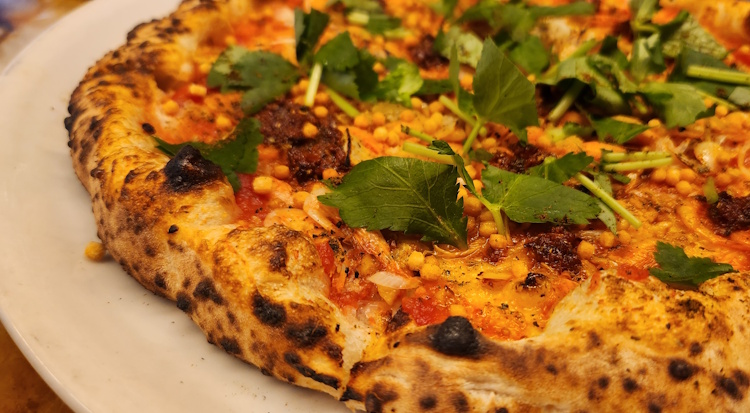
For my very last bite… with just a bit of crust, I squeezed up some of the excess parsley that had fallen onto the plate, along with a lonely shrimp, and captured a few of those crunchy crackers. There was some additional surprising flavor I couldn’t quite nail down… maybe a spice of some kind (?) and…
That pizza, on my first time at Marumo, was something altogether different.
Of course this blog is famous, in part, because I am the Official Hakujin Pizza Czar of Japan. (Thank you, thank you, you’re welcome). As such, I have eaten hundreds of pizzas in Japan, including from the best pizza restaurants in Tokyo, the vast majority the pizza in Osaka, a full tour of Nagoya’s pizza shops, all of the pizza restaurants in Sapporo… you get the point. Most of those pizza places in Japan are Napolitana style. It is a feature of Naples inspired pizza in Japan that you can watch the pizzas being made. As such, I have watched hundreds of pizzas being made in Japan, and… I have never seen anything like what they are doing at Marumo.
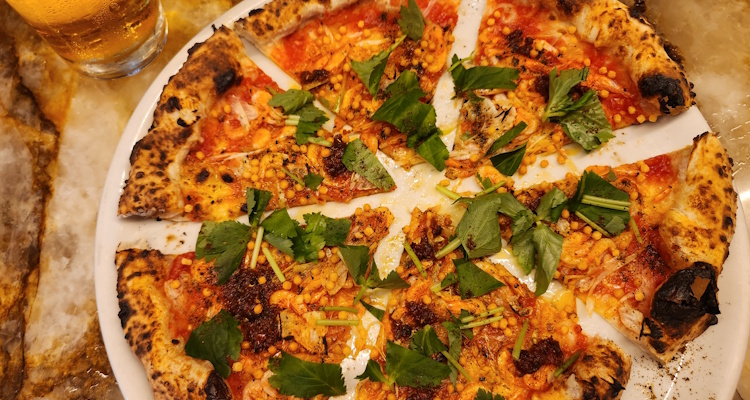
For a local, Tokyo-specific pizza reference: We recently reviewed Savoy Pizza in Asabujuban; I like that shop and I gave them a great review. Many people consider Savoy to be “top shelf” pizza in Tokyo, and it is. And yet… it is certainly not on the same level as the Japanese Black Chili Pizza I had that day.
Pizza Marumo is in a different class. In both the craft of the pizza, and (more importantly) the taste that is delivered to your table, Marumo was absolutely one of the finest pizza experiences of my life. I did like the service, but here I am specifically getting at the taste.
We’ll write a “best pizza places in Tokyo” article later, and Marumo – for now – is head and shoulders at the top of that list. What they are doing at PST Pizza (in Rippongi) is also fantastic, and is a close second to Marumo, but Marumo takes the rather generic category of Neapolitan pizza and has created something completely unique and spectacular.
It can be good to be original, but it can also be hard to create something unique that doesn’t turn out “gimmicky” in the end. I don’t need my pizza to be “funny” or “clever,” and I don’t care what it looks like on “Instagram.” In that Japanese Black Chili I have admittedly sampled only a portion of the menu, but in that choice – it was clear Marumo has been able to “thread the needle” and arrived at a pizza that is comes off with a symphony of flavor.
The rice cracker part: I am surprised at how much I liked that element, and the unforgettable effect those little, toasty (fried?), crunchy balls had on the pizza. The rice cracker balls perform the miracle of adding “sound” to a pizza (there is a literal crunch), and then creating such a phenomenal contrast to the fresh-garden taste of the parsley. So many “distinct voices” coming through, bite after bite.
Bravo.
I confess that I wrote this review some many days after eating the pizza. And despite the delay – I can still “taste” it. I still crave it.
As Pizza Czar, it is not my job to “be nice” (it’s not my goal either). If I don’t like a place, I am happy to tear it apart (ex: see my review of Regalo Pizzeria in Osaka… hated it). In this case, I am as flattering as I am because Marumo Pizza deserves it.
Okay. So I liked the Japanese Black Chili. We’ve established that.
There is more on the menu. There’s a category of mayo-based pizza that includes the Teriyaki Boys Pizza (which sounds like a terrible mistake to me). There’s another category of vegan pizza, which is a little too 2010-trendy for my tastes (be gourmet when you can, and be “vegan” if you must, but doing both is probably asking for too much). Not all of that looks good to me… (I told you I’m not always nice).
I am also not a big fan of putting eggs on pizza (even though that is also an instintual Japanese move), but… just look the Bismarck 2.0 at Marumo in Tokyo:
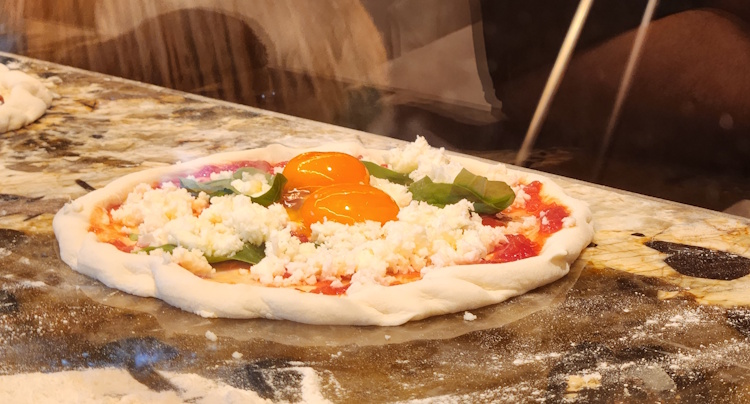
Again, you’re seeing the uncocked creation, but if you’ve seen many pizzas come together, being able to peer into the process at this stage can help to show you what is in store for you when you are in-house.
Really high-quality ingredients, generously applied.
As a “dirty American” (formerly American, American by birth…) I like simple neighborhood pizza more than “thin crust.” The standard neighborhood “Italian pizza” from America has a heartier, thicker crust, and more toppings. By comparison, the “authentic” Napolitana pizza in Japan has a very thin crust and very few topping. Pizza Marumo in Ebisu departs from “strictly authentic” to make a crust that is not only incredibly tasty, but is strong enough to hold the layers of ingredients that go into their work.
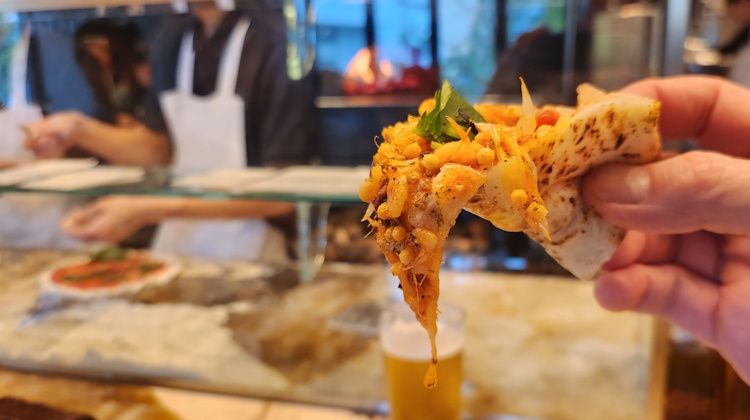
Marumo passes my famous Pizza Czar “pizza test”; you can pick it up. Even as it’s loaded with toppings, and (as you can see in these pictures) literally dripping with love.
I mentioned that I do indeed want to try the Marumo Japanese Umami pizza, but that wasn’t even really my second choice on that day. In the Cheese-based pizzas category of their menu, there was also a lamb pizza that sounded incredibly tempting.
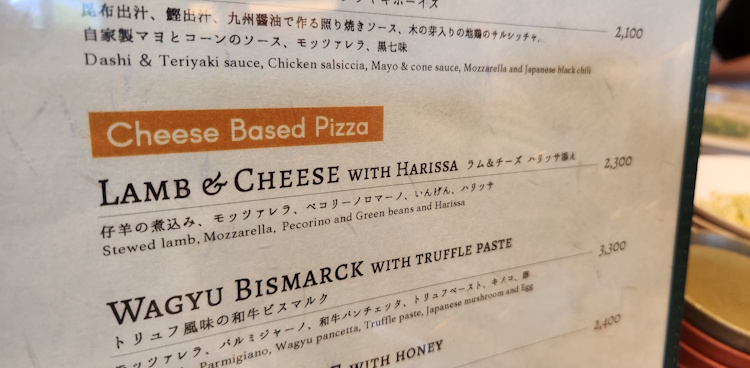
“Pizza Marumo Lamb and Cheese Pizza: Stewed lamb, Mozzarella, Pecorino and Green beans and Harissa.”
Hmmmmmm. Having spent a lot of time in Sapporo, I have learned to love lamb. Lamb is a Dosanko specialty, and it comes through from the shelves of the super market, to the “Genghis Khan” BBQ tradition, to lamb-based pasta sauces; I have had so many good experiences, I am open to lamb, any time. The “stewed” part makes me wonder if the meat would be “soupy?” We did a review of the Asabujuban Savoy Pizza and their Japanese Beef Pizza was “stewed” and wasn’t a completely successful pizza (I would not order it again). I am very curious to see how Marumo would do lamb and cheese – and it still sounds fantastic.
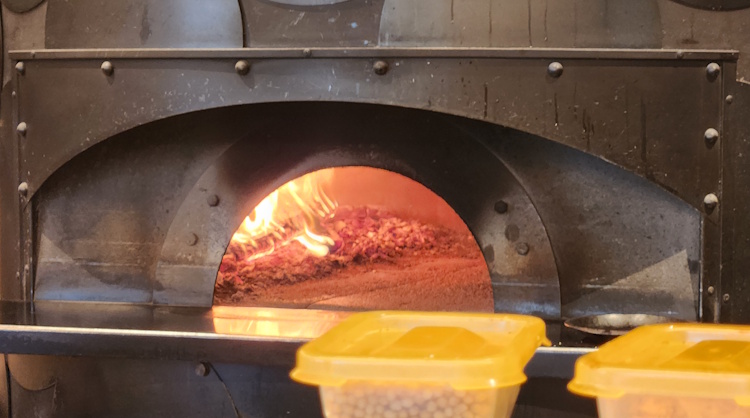
Yes, they serve wood-fired pizza at Marumo, but so do 100 other pizza restaurants in Tokyo (who cares). The oven doesn’t even make it onto the list of amazing qualities at Marumo, and I could not be convinced it is responsible for the superior flavor.
Beyond pizza, there were two pages of appetizers including prosciutto, focaccia, some warm appetizers like cauliflower, roasted vegetables, and, and a wagyu trippa stew. I wanted to try something besides pizza so I had the Marumo salad (with soy sauce and sesame dressing).
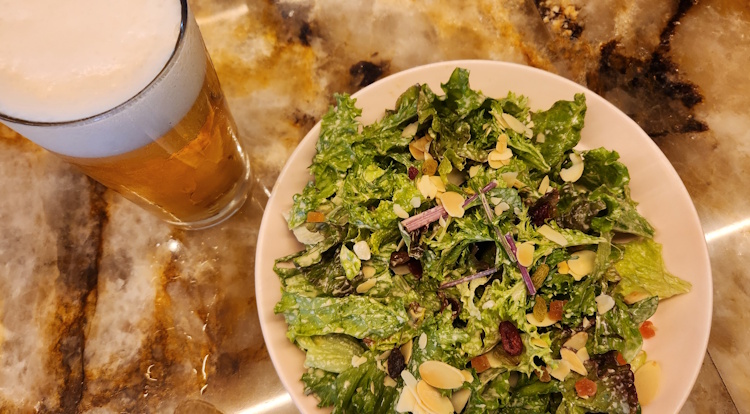
The salad (pictured here, is a small) – came out overflowing the plate. I was surprised by the array of multicolored raisons and slices of almonds. The dressing I might have expected to be dark based, on the soy, but it arrived looking white and creamy, and reminded me more of a Caesar than either soy or sesame. The almonds were too much and the salad was – just okay. Not great. Unlike the pizza, I wouldn’t do it.
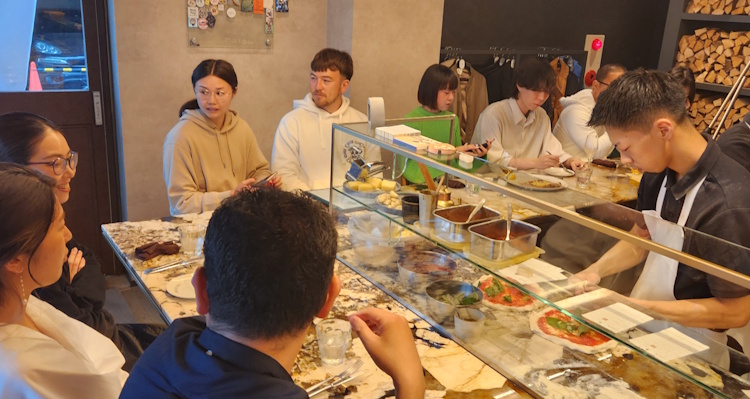
Price can matter, but economics is not particularly in the plot line for this blog. In this case, when the bill arrived at under 4000 JPY for a beer, a salad, and easily one of the best pizzas in the history of pizza… it felt like a bargain.
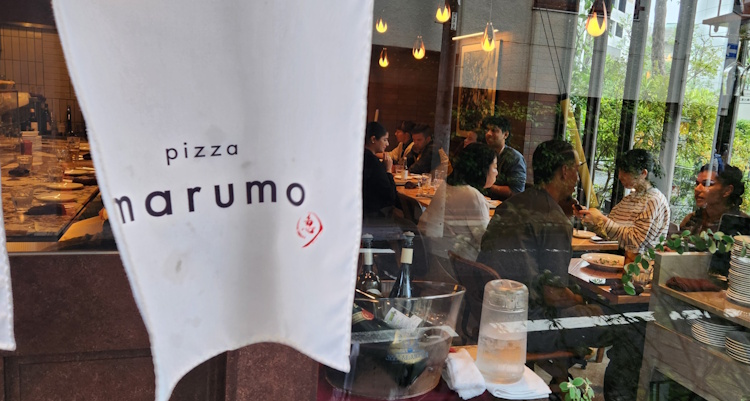
I was genuinely humbled by my lunch that day. I mean it.
Even after having 100s of pizzas in Japan’s finest pizzerias, I learned some more that day about the potential of pizza. Marumo made me like Napolitana pizza more, even as their quality made other options in Japan look redundant and pedestrian.
If you can get a spot (and you can reserve online), you should do it. Perfect 10. Fantastic.
For more Tokyo Pizza see:
— Pizza Bar on 38th at the Mandarin Oriental Hotel in Chuo City, Tokyo
— Go try the seafood pizza at Massimotavio in Suginami City, Tokyo
— Pizza Studio Tamaki in Rippongi, Tokyo
— Excellent Detroit-style pizza at Pizzakaya in Rippongi in Minato City, Tokyo
— Sabasu Pizza in Akasaka, Tokyo
— Savoy Pizza Domi-LA in Asabujuban, in Minato City, Tokyo
— Pinsa at Bonta Italia in Sarugakucho, Shibuya, Tokyo
— Devil Craft Pizza in Kanda, in Chuo City, and also the DevilCraft Gotanda, in Shinagawa, Tokyo
— Shibuya pizza at Kevelos, in Tokyo
— Frey’s Famous Pizza in Rippongi, Tokyo
— Seirinkan Pizza and Beatles music in Meguro, Tokyo
— Risto Pizza in Azabudai, Minato City, Tokyo
— A star-shaped pizza at Pizzeria da Peppe Napoli Sta’ Ca” Komazawa, located in Setagaya City, Tokyo
— Chicago-style pizza at Butcher Republic in Ebisu, Tokyo
Pizza Slices in Tokyo
— Saturdays and Sundays only: New York Pizza Tonyz Tokyo in Koto City, Tokyo
— Rocco’s New York Style Pizza slices in Ojihoncho, Kita City, Tokyo
— Pizza slices at Nim’s in Azabujuban, in Minato City, Tokyo
— Very mediocre pizza at Pizza Slice on Cat Street, in Shibuya, Tokyo