
Pizza Bar on 38th in Chou City, Tokyo
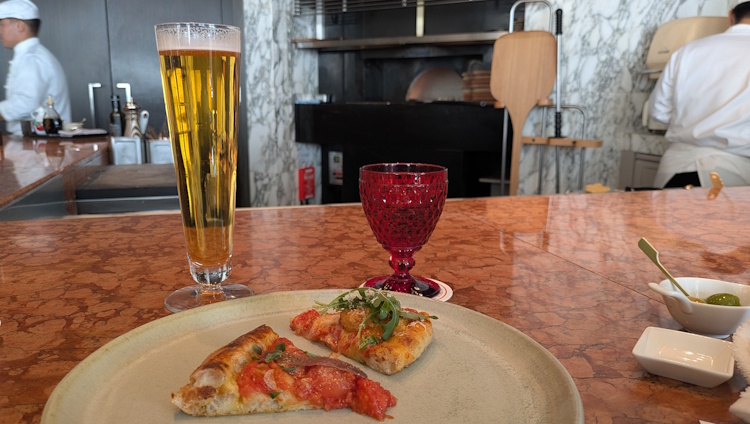
As part of our series on the best pizza in Tokyo, we present our review of Pizza Bar on 38th, located in the Mandarin Oriental, Tokyo. While the best pizza in Tokyo may be subject to the personal tastes of the taster, there can be no doubt that Pizza Bar on 38th offers on exquisite pizza experience.
Below we offer some notes from our visit, as well as many original pictures so you can see what we saw for yourself.
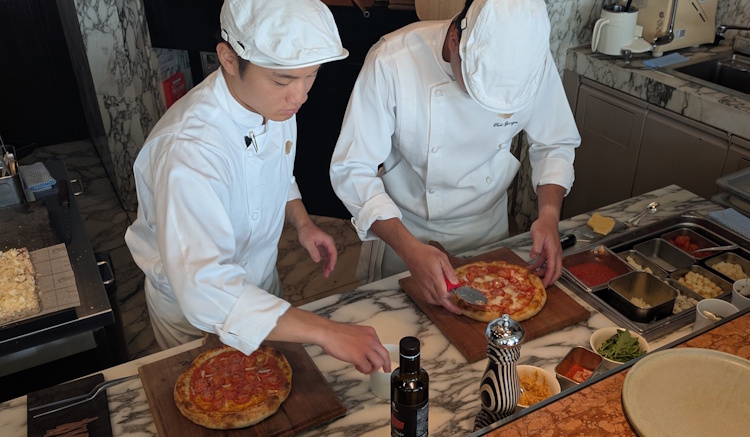
Before we begin: You should know that Tokyo’s Pizza Bar on 38th is entirely reservation-only (more on reservations below). In my experience as Pizza Czar of Japan, this was the most difficult reservation I have ever successfully acquired, anywhere, at any restaurant.
Once a reservation has been secured, the phenomenon of a meal at Pizza Bar on 38th begins with your arrival at the Mandarin Oriental, Tokyo.
Pizza Bar on 38th is built into a larger space of the Kshiki restaurant, which is a feature of the hotel, itself a part of Nihonbashi Mitsui Tower, all of which sits nestled into Mitsukoshi Mae Station, in Chuo City. Arrive early; it can take a while to navigate the station.
Just beyond an information desk on the ground floor of Nihonbashi Mitsui Tower, tucked behind the escalators, there is a understated passage that leads to a sophisticated interior lobby for the Mandarin Hotel.
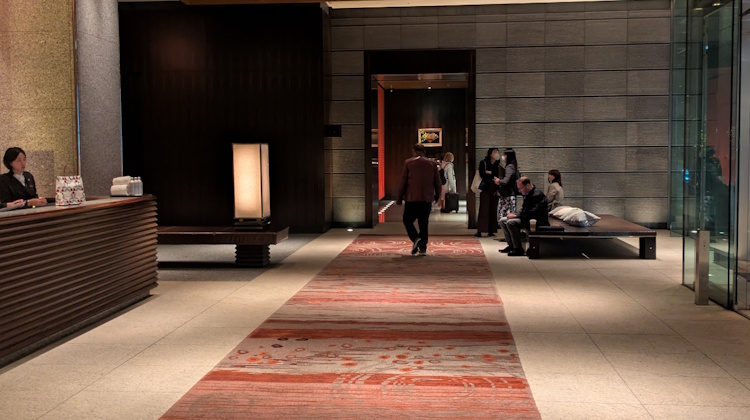
From the lobby, it is up and up via the elevator to the 38th Floor, and a more hospitable second lobby, with genuinely impressive views and the hotel’s restaurant, Kshiki.
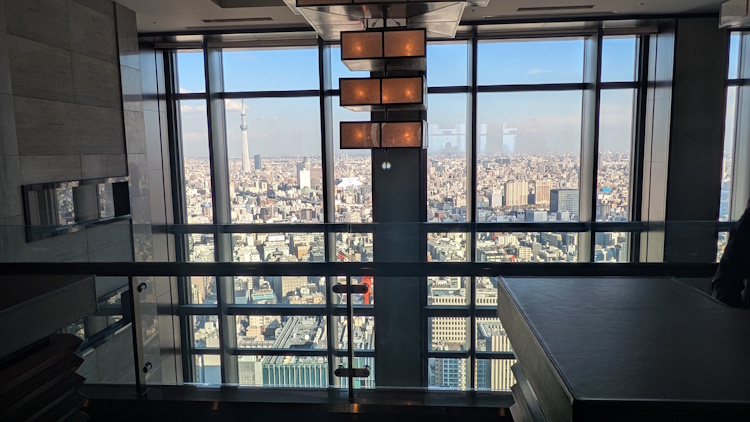
The name Pizza Bar on 38th feels like a reference to “38th Street” (the signage encourages that association), perhaps from a city like New York.
In this case, the pizzas are created from a location on the 38th floor. Thus the name:
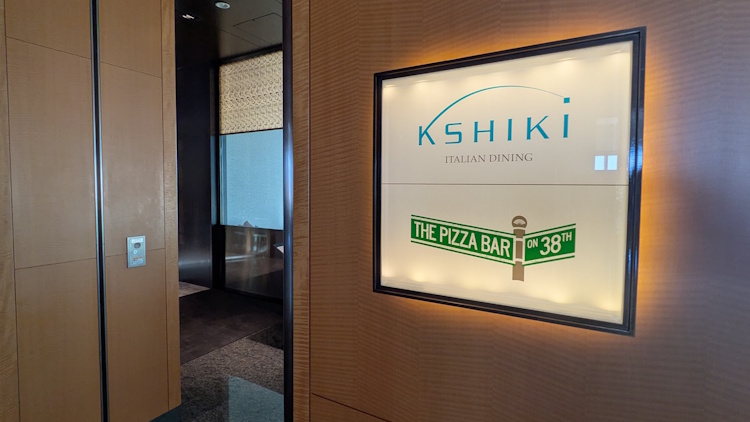
Four times a day (twice for lunch, and twice for dinner), exactly eight guests are seated at a high-top, “L”-shaped granite bar, tucked into the corner of Kshiki.
Before my visit, I imagined small groups of two (or one), quietly enjoying the delivery of several different executions of world class pizza. What I wasn’t expecting was that dining at Pizza Bar on 38th was to be as much of a tour as a meal, and is in some ways a group experience.
For the menu, we owe credit to the Mandarin Oriental, Tokyo’s executive chef Daniele Carson. The specific meal, however, was presented by two of his staff; these two men would host the meal, and provide the education of the guests along the way.
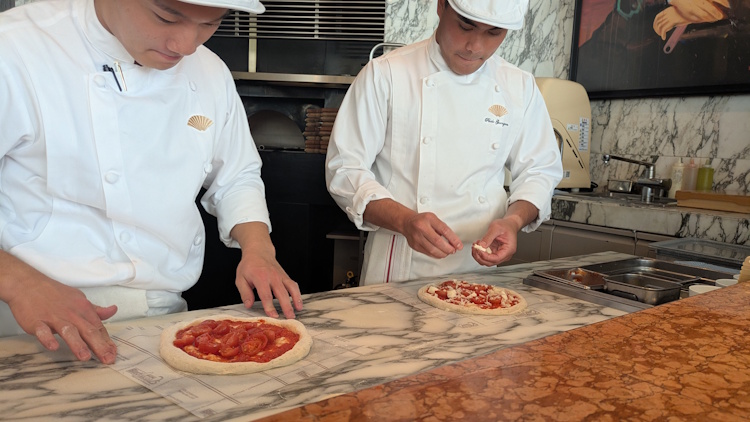
Our guides for this meal were sous chef Paolo Guanzon and commis Koki Tanaka. I will refer to these two gentlemen in my usual way, as the “pizza masters.”
At Tokyo’s Pizza Bar on 38th, these pizza masters not only prepare and serve the food, but they explain many of the details, helping to heighten the presence and the attention of the guests to everything that is happening before them.
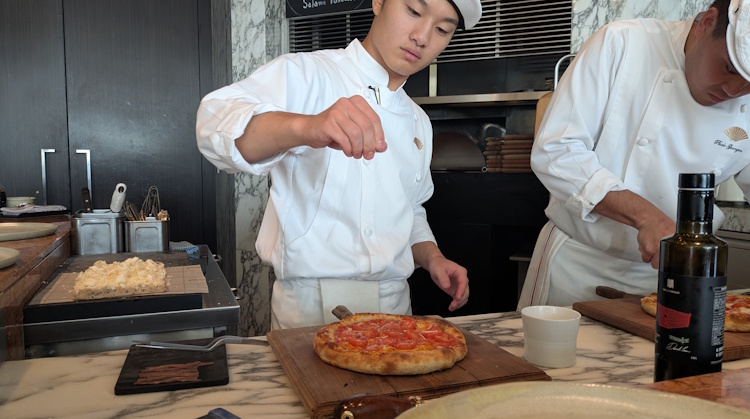
As you can see, the Pizza Bar is an open, exhibition kitchen. While there is plenty of time to eat and talk amongst yourselves, there is an ongoing conversation with the pizza masters. It is a rare feature to be able to ask questions as your meal is prepared, and is part of what makes dining at the Pizza Bar special.
The product of their process is as much about the preparation and presentation as the actual pizza. As it is served, the pizza itself is a work of art.
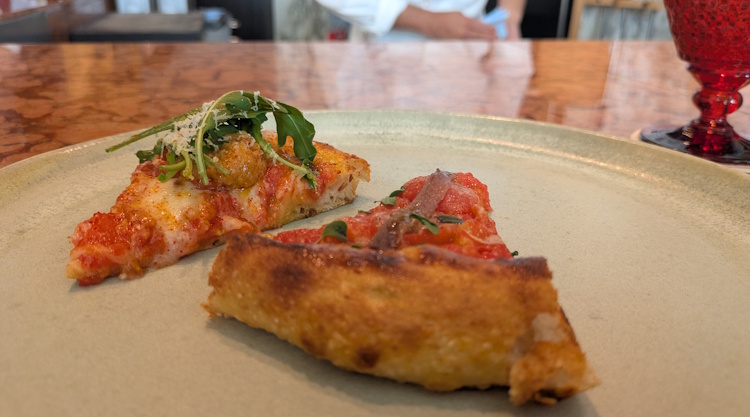
The meal is divided into eight parts; proceeding at a leisurely pace, the full story from appetizer (part I) to dessert (part VIII) unfolds. All told, there would be five distinct pizzas in the tasting (plus a pizza-like hors d’oeuvre and something called a pizzino).
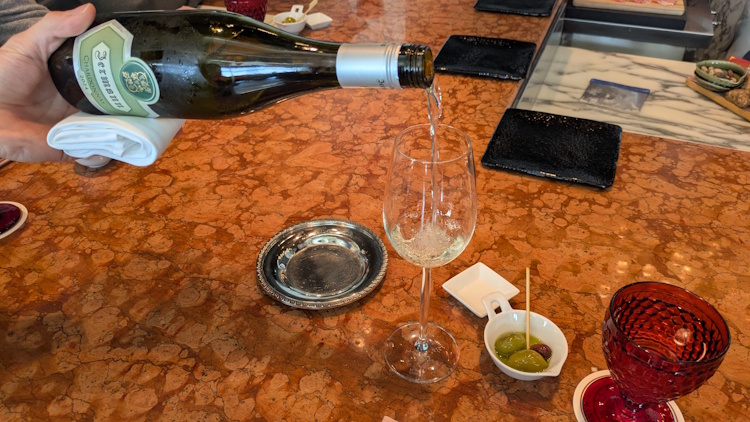
My lovely companion ordered a glass of wine (from an extensive wine menu). Per my usual pizza routine, I ordered a beer. Even in an environment like this one, pizza and beer. Even here, an excellent combination.
As a part of the initial introduction, one of the pizza masters explained that the meal would be in an omakase style. The chef would later elaborate and say that while they used to do a la carte pizzas for guests at the restaurant, the omakase course allows the guest to try more varieties – and that proves to be a very successful idea, indeed.
As part of the education, you will learn they that Pizza Bar on 38th procures the ingredients in a “farm to table” fashion, and that “80%” of the ingredients are local to Japan.
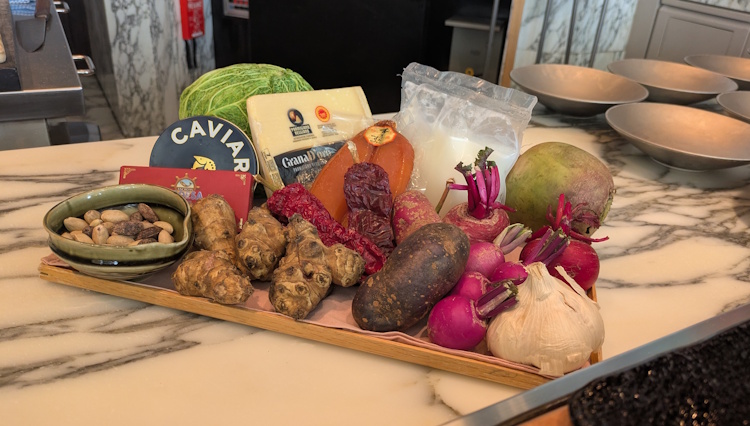
For example, we would hear that the garlic came from Okinawa. As a big fan of the northern-most island of Japan (and very proud of our SapporoCity.com project), I was personally happy to hear that both the potatoes and the crab used in the meal came from Hokkaido.
As the meal began to build momentum, one of the pizza masters brought out a ball of dough, a slightly tan-looking dough. From my notes:
“80% hydration in the dough. Seven different kinds of flour.”
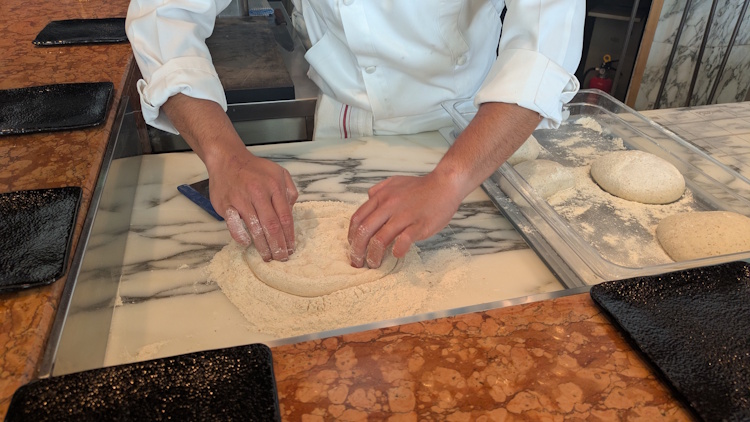
This is not Neapolitan-style pizza. You will learn that chef Daniele Carson is from Rome, and that the style of pizza at Pizza Bar on 38th is “pizza alla pala” (the “pala” is a reference to the wooden peel used to take the pizzas in and out of the oven). If you have experience with high-end Napoletana pizza in Japan, you’ll will notice some obvious differences in the crust produced by this dough.
That first mound of dough was stretched and kneaded out, with knuckle-deep impressions. It was quietly and unceremoniously baked in the background.
What was delivered was something like a focaccia appetizer; an undressed focaccia, with something like prosciutto, a bit of oil, and salt. Light, the salt and meat flavor dominating. An excellent start to the meal.
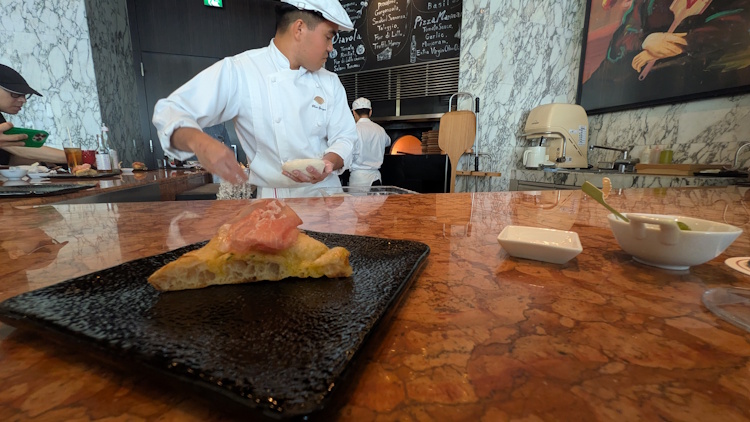
This starter (which was not on the course menu) was pizza-like, but not as flat in the middle (more like something from a bakery). I asked if it was “pinsa,” and our pizza master corrected me; pinsa is also from the traditions of Rome, but while there is rice in pinsa, there is no rice flour in the dough used at the Pizza Bar. We were to eat pinsa the next day at Tokyo’s Bontà Italia, and while the dough has a different composition, pinsa was similar to this appetizer in it’s bread-like crust (if a bit crispier at the edges).
From there, we moved on to a proper appetizer, which was served as the official Part I of the meal:
Tonno Pinna Blu: Dry-Aged Sustainable Bluefin Tuna, Turnip Vellutata
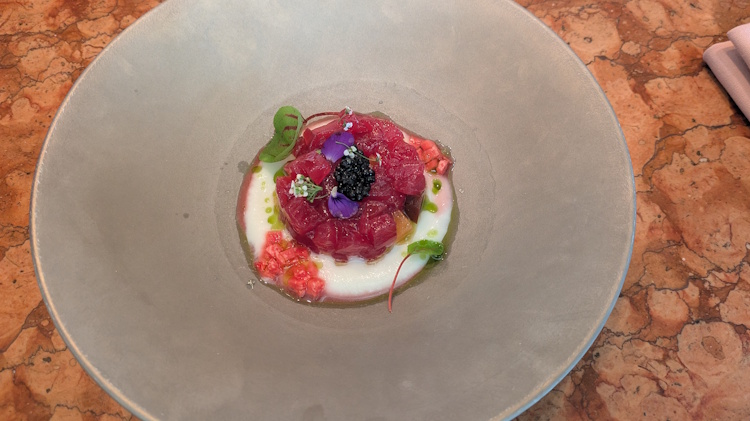
The vellutata, beneath the rainbow of ornamentation, was thick, like a heavy soup or a porridge.
From my notes: it was made of two kinds of turnip, with some tuna, and some caviar. Savory. While it was radical to look at it, in terms of flavor it was maybe the least remarkable aspect of the meal. For my tastes, the little cubes of crunchy pink vegetable (perhaps one of the two turnips?) was the most notable part (for it’s flavor and it’s texture).
The series of courses was extensive, and while the meal rolls out over the better part of two hours, the action comes like fireworks; one burst of amazement after another.
Quickly, we were into the thick of the pizza action. The first two proper pizzas were prepared and served together.
Part II of the meal was the minimal Marinara, this time, with anchovies.
Marinara: San Marzano Tomato, Garlic, Marjoram, Anchovy
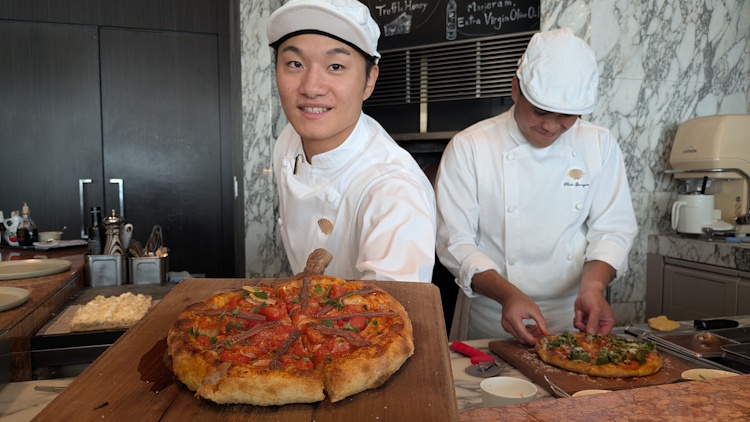
That is a beautiful pizza.
Because I was expecting traditional, Neapolitan-esque pizza (ubiquitous in Japan), I was happy to notice the surprises in the alla pala style; certainly some uncommon qualities to the crust.
The pizza crust was a fairly even golden brown, not blackened and leoparded like a Napoletana. It looks more like the crust of a Chicago pizza (ah ha, there is a reason for that). This crust was very light, and had a crispy, almost “fried” quality, with tiny, crunchy bubbles on the outer surface (again, like a Chicago pizza). My guess at the time was that there was some oil in the dough (I have since confirmed that alla pala dough often does have olive oil in the preparation).
It was very good. A fine pizza. Other than the crust, it is my opinion that this pizza was like most Marinaras, mostly unremarkable. While I am occasionally surprised (the Marinara at Da Massimo in Sapporo is simple but shockingly good), I would almost never choose a Marinara when there are other choices available.
Interestingly, as the chef came out to greet us later in the meal, I had the opportunity to ask which of the pizzas on that day’s menu was his personal favorite; he quickly declared it was the Marinara.
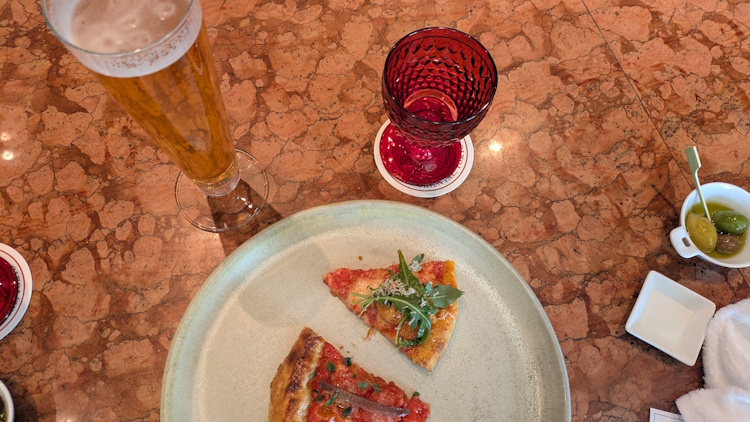
Part III was a Diavola; also an Italian classic, one that is closely associated with some spice, and a pizza that is remarkably common across Japan (maybe the fourth or fifth most common pizza iteration). Every pizza shop that produces this variety does so in it’s own way (some marvelous, some miserable). In this case, the spice in the “Devil’s pizza” comes from an in-house salami.
Diavola: San Marzano Tomato, Cherry Tomato, Arugula, House-made Nduja Salami
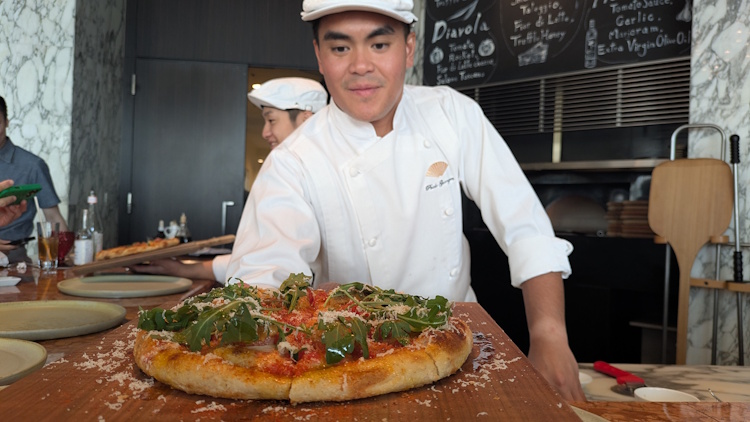
The Diavola was more interesting, the arugula capturing much of the attention. I have had a few “salad pizzas” in my time as Pizza Czar, and in this case, the bitter arugula played a lovely counter-note to what is otherwise a very good “pepperoni” pizza. Delicious.
At this point in the meal, we were eating pizza. And I liked it.
Part IV was very un-pizza-like; listed as a “pizzino” on the menu. If the first two pizzas were simple, traditional pizzas, the pizzino was the first example of a multi-layered “construction” of flavors.
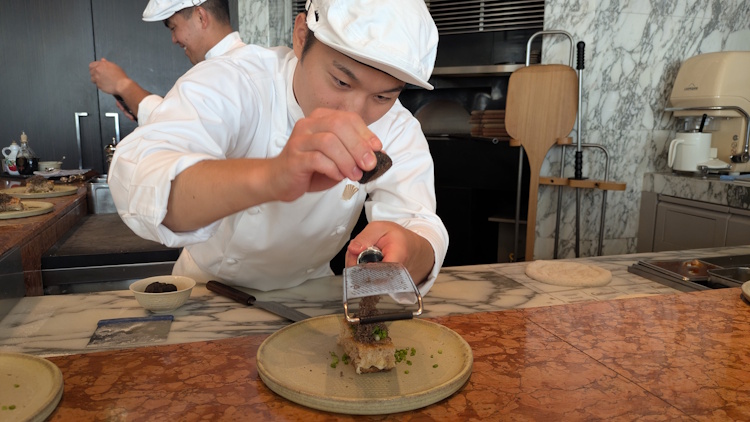
Starting with an airy bread, split in half, the bread is layered on with Buffalo Mascarpone (you can see it in the background of the picture where the Marinara is presented), then baked in the pizza oven. After, a small pile of something like green onions is applied, and then fresh truffle grated over top.
Pizzino: Buffalo Mascarpone, Black Olive, Fresh Truffle
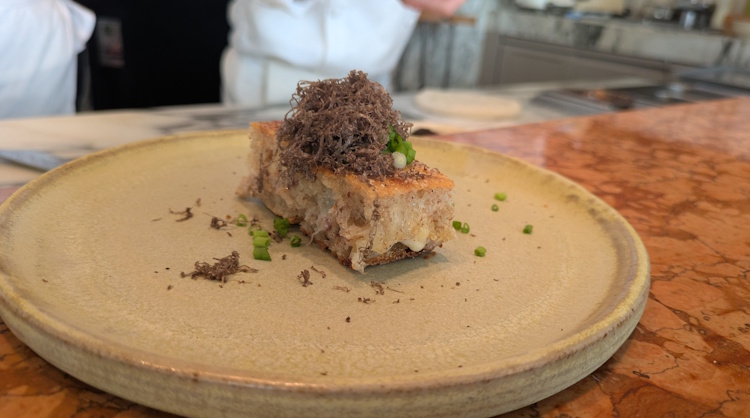
Before the rectangular “slices” were served, some Asin Tibuok sea salt was applied. Our pizza masters explained that this salt is among the most rare and special in the world.
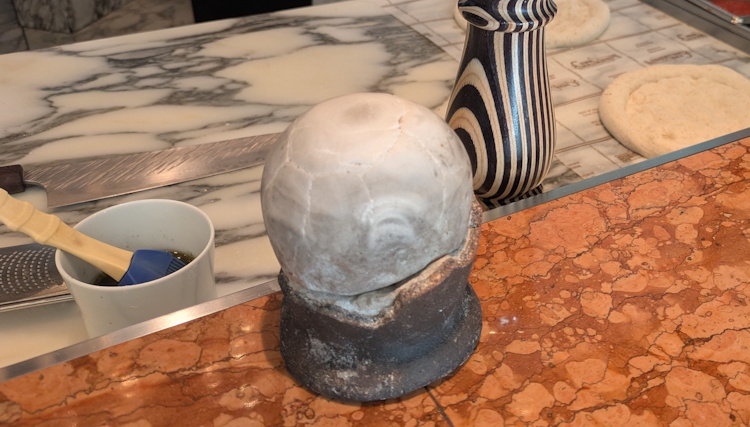
The Asin Tibuok specialty salt is a product of the Philippines, derived from sea water, and its production involves a coconut shell. Fascinating.
Throughout the meal, our group relaxed. A few of the guests asked questions, and the “professor” gave us informative and entertaining answers; sometimes about ingredients; or cooking methods. One guest talked about creating his own pizza at home, getting some tips on using a pizza stone (or perhaps cast iron).
When a guest asked as to how the pizzino was to be eaten, the pizza master said:
“However you eat your grilled cheese, Sir.”
This was said by the pizza master with a cocky, instructor’s confidence (it was a wonderful moment of showmanship, I’ll never forget it). And yes, “grilled cheese,” a prefect association.
The truffle grilled cheese was incredibly rich. A little too much so for my simple tastes. The chive-onion element sang through as a refreshing contrast to the heavy-oil of the cheese and the savory truffle flavors.
If the meal had stopped at this point, I personally would have been wonderfully satisfied. By this point, I was fully immersed, swept away. I felt like I’d already experienced something new, something fresh and refreshing.
The most intricate pizzas, however, were just coming into combination; two more pizzas, very different from each other, were assembled side by side. The names were Italian, but in each the essence was pizza in a seafood theme.
Part IV was pizza #3, a crab and potato pizza – which may have be inspired by an Italian salad (from Tuscany? Called insalata di polpa di granchio e patate?).
Granchio E Patate: Provola Affumicata, Colorful Potato, Zuwai Crab, Aonori Sea Vegetable
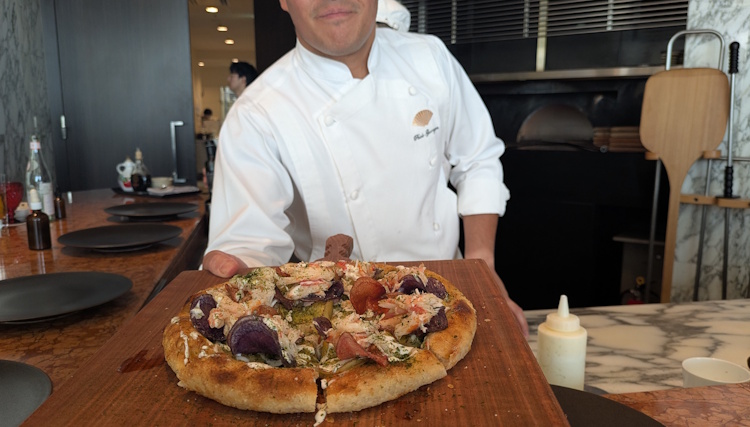
In my notes this was the “potato chip” pizza. While there were fresh slices of potato closer to the crust, in addition to Hokkaido Zuwai crab, the pizza is topped with potato chips in red and purple.
Extravagant. While crab can have such a sweet-strong taste, it was in-blend in the wild ensemble of so many other flavors. This is a pizza of layers on layers.
Part V of the meal (pizza #4) was a raw shrimp pizza. Shrimp pizza, and most certainly “ebi pizza,” is a perfect example of a pizza personalized to Japan. I am interested in seafood pizzas in Japan, and this was a stunning example.
Gamberi Botan E Pistacchio: Botan Shrimp, Bronte Pistachio, Sea Asparagus, Fontina Cheese, Stracciatella
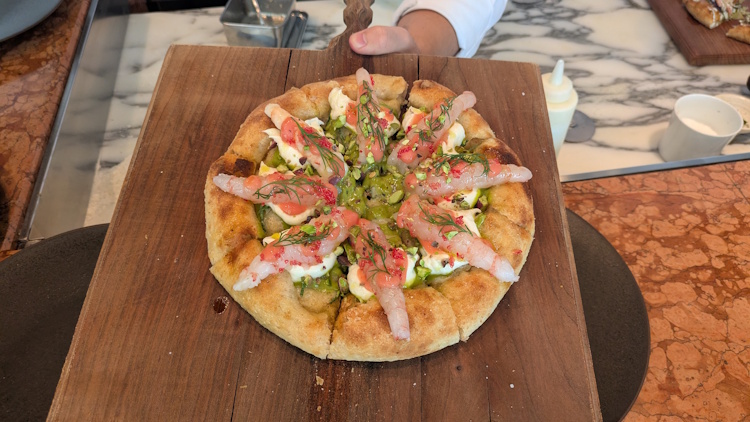
As if the crab pizza could be upstaged, this was perhaps the most fantastic and flamboyant of the five. Upon first taste, my lovely companion said she could smell flowers. My first bite reminded me of strawberries – strawberries and cream. The fontina was light, maybe whipped to the consistency of sour cream.
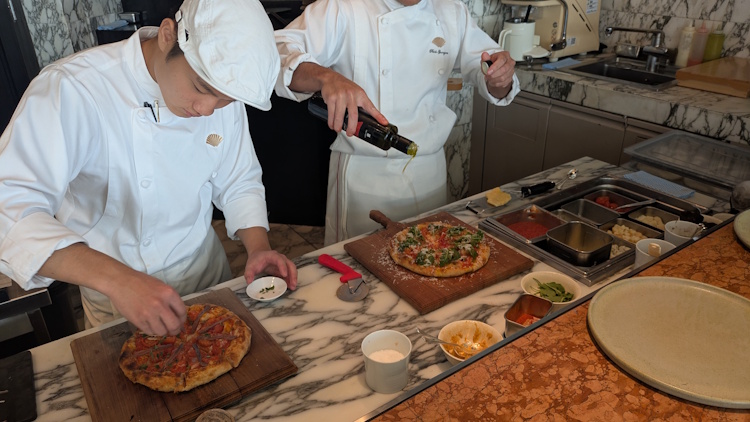
At Pizza Bar on 38th, the process goes well beyond a few ingredients sprinkled across the dough; these pizzas were built up; layers of intricacy, layers of intention; presumably for flavor, and for aesthetic, and perhaps also to add flourish and for fun.
Here is a look as the first few layers were laid down in the assembly of pizzas #3 and #4.
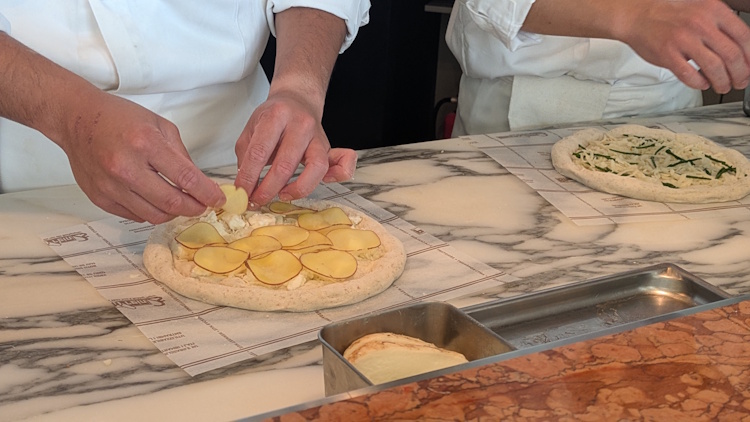
I’ve watched hundreds of pizzas being made, in dozens of shops all across the major cities in Japan. I was very prepared to watch, attentively, and to take notes (which I did). I was also completely dazzled. It was to sit within a symphony – almost overwhelming.
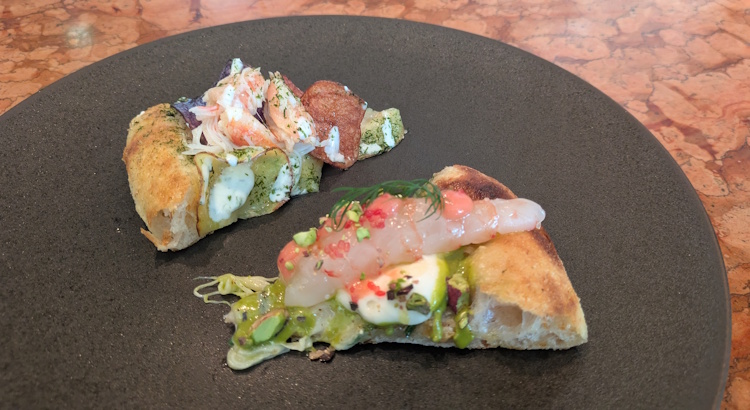
As you can see, these pizzas were absolutely extraordinary.
When I write a review of a pizza restaurant, I like to note if the pizza can be eaten by taking it in hand…
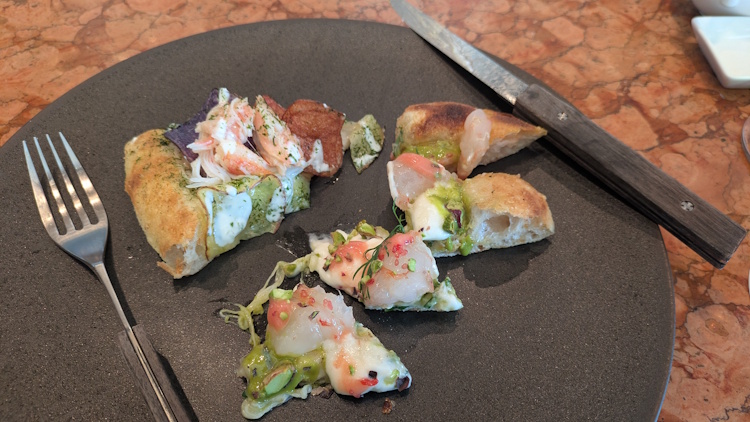
While some of the earlier executions could be easily picked up; these two pizzas were peak “knife and fork.”
If I was satisfied mid-meal, pizzas #3 and #4 put me into a mid-meal mesmer. As the next stage of the pizza experience was prepared, I was increasingly relaxed, almost subdued… like the feeling people imagine when they think of “vacation.”
Part VI (pizza #5) was a variation on the also-classic four cheese Quatro Fromage; in Pizza Bar on 38th-style it was to be the Sette Fromaggi (as in “seven”).
Sette Formaggi: Provolone, Gorgonzola, Scamorza, Teleggio Fior di Latte, Parmigiano Reggiano DOP, Pecorino Romano DOP, Truffle Honey
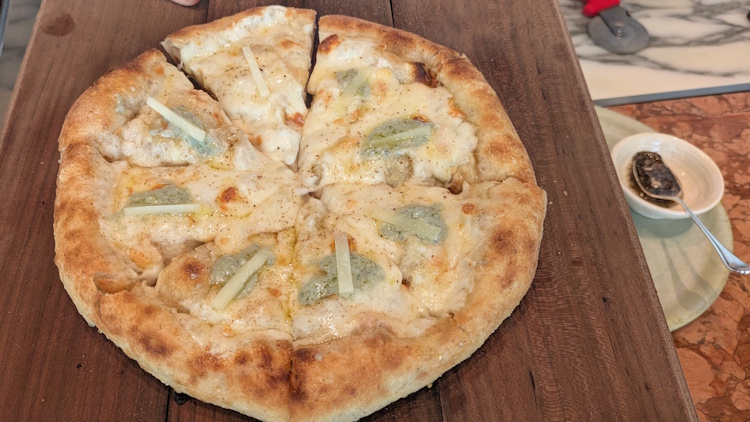
The Four Cheese-type of pizza is also common in Japan. Like this example, it is typically paired with honey – with the honey-sweetness playing opposite the rich, salty-savory of the cheese. With some exceptions (the Makino Farms cheese pizza in Sapporo is extraordinary), I typically look right past the Quatro Fromage category (the cheese can easily be monotonous, and the honey, overwhelming). In this case, I was prepared to take a bite; I wasn’t expecting much…
As the slices were served, the pizza professor made a point to suggest some of the hot-chili oil we’d be given at some other point in the meal (which I had yet to try). I applied a liberal dosing of “hot” to the cheesy surface. I took a bite… and this really was a “seven cheese pizza” that existed on another level.
I don’t typically like four-cheese pizzas, but I was captured by this execution. The seven cheese pizza at Pizza Bar on 38th was to deliver the most memorable bites of the meal; it was a surprise, in a series of surprises. That red-oil heat helped clean up the heavy-sweetness of the honey.
This review has so much praise, for so many pizzas, and here I was, eating a pizza I don’t often enjoy, and loving it.
It was around this time that Daniele Carson himself stepped onto the “stage.” Here he is, mid-gesticulation, like a proper director, positioned behind his sette formaggi as it sits center stage.
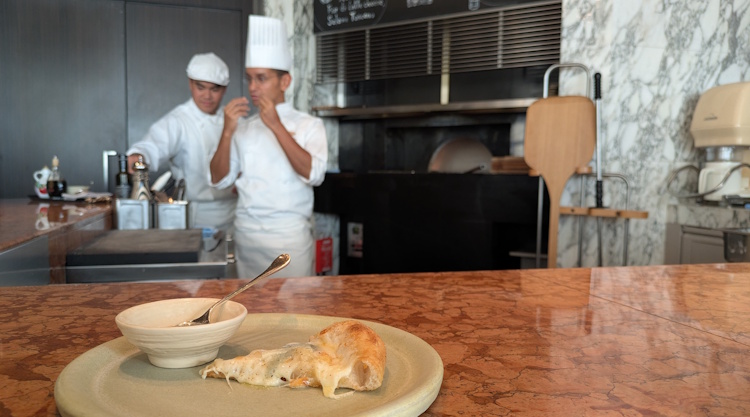
Chef Carson is cool. He has a wonderful masculine gravity, a calm grace – as if he had walked in to find a group of kids snacking in the kitchen in his home. I was happy have a chance to see him. I am grateful he is so good at what he does.
Thank you, Chef Carson.
Part VIII of the Pizza Bar on 38th tour de force was to be dessert. The primary pizza master asked if we might be okay with a little bit of espresso? And maybe some amaretto liqueur? My notes from that moment say “gellato,” but perhaps I hallucinated that detail. According to the menu, dessert was to be a Chantilly.
Affogato: Hazelnuts Praline, Vanilla Chantilly, Amaretto Velvet
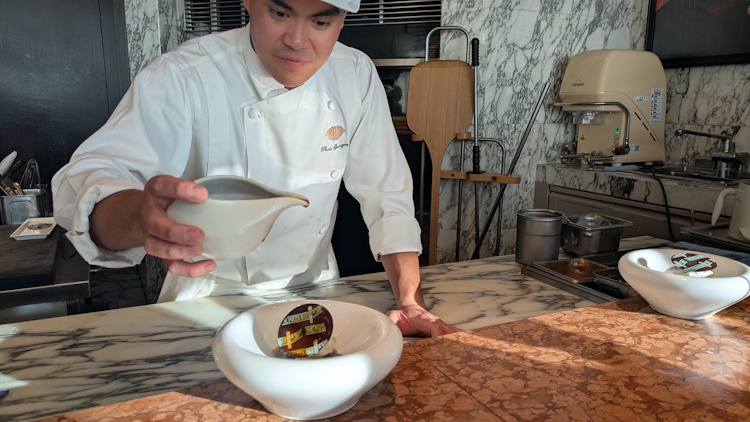
Each guest had a creamy creation set before them. Then the master tipped a porcelain saucière full of warm coffee-amarillo over each person’s portion; the thin, crowning chocolate disk was melted in the steamy stream. My notes show that the first taste I could identify was the hazelnut; then the crunchy-cookie, caramel-like flavor of the praline.
Fantastic.
Just remarkable.
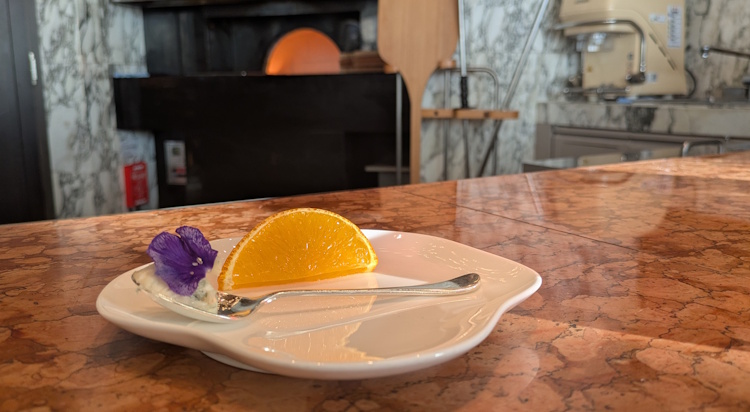
There was yet another (and another) off-menu stage to the meal; a palette cleanser of fruit (super-ripe Japanese mikan) and cheese (salty gorgonzola), with a flower petal.
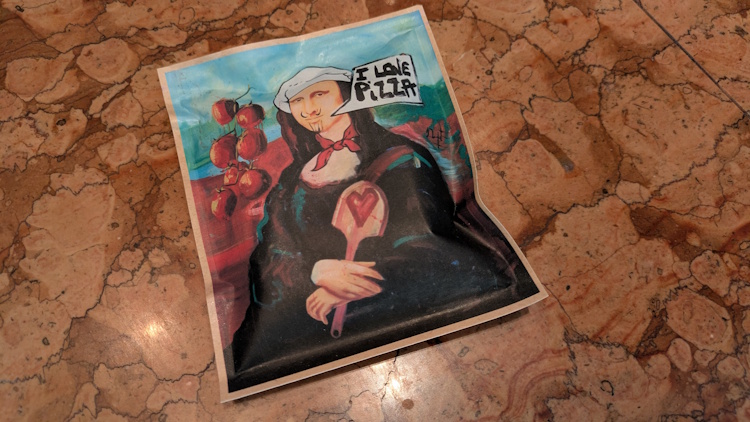
Some final gestures: Each guest was given a copy of the menu (with their name at the bottom) and also slipped a small package; a “to go” cookie, in a wrapper featuring the Pizza Mona Lisa (from the figure on their wall, above the kitchen).
As the meal wrapped up, I was in a daze; a broad, slow smile across my face. Some guests had already slipped away, but I was still interested. I took a few more pictures, and was the last to leave.
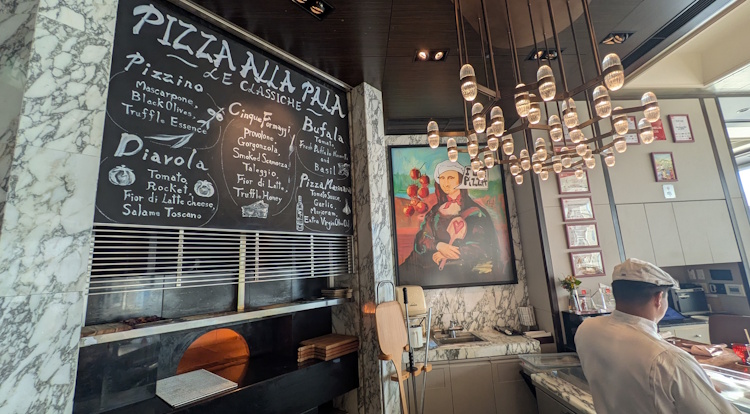
The professor was still at his station. I thanked him. It was the pizza equivalent of when a kid approaches a professional athlete to ask for an autograph, and to say “he’d played such a good game.” I was certainly a fan.
We will end the review with some comments about how to get a reservation at Pizza Bar on 38th.
It’s really not easy: I didn’t initially understand how difficult it was to get a seat “at the bar.” I had once naively tried to get a reservation with two or three days’ notice (there are openings from cancellations, but that is mostly not how it works). Later, I tried booking a reservation several weeks in advance, and saw there was nothing available. I had given up, but then I came across a post online that noted that reservation were to be made at precisely “midnight,” weeks before you’d like a seat. You are to strike then, or miss your opportunity.
In advance of another trip to Tokyo that was taking shape, I spent several sessions exploring the simple (but not entirely clear) reservation process available via a link from the Mandarin Oriental Hotel site. For the upcoming trip, I would be in Tokyo for three nights, so; At the appointed time (midnight, Japan Standard Time), a month in advance to the day, I tried to grab a seat. And then I tried again. Night after night (at midnight, each night). I finally scored two seats for lunch on my last attempt.
Is it difficult to get a seat at the Pizza Bar on 38th? Yes, I’d say so; competitively so. And, for most diners, the cost may be prohibitive as well; the per-person charge is something like 18,000 JPY, plus a service charge, plus tax. With drinks, pizza for two was over 50,000 JPY. That is 5X to 10X the cost of a very fine pizza meal in some other establishment. I don’t say any of this as a criticism, only as an accuracy.
On the wall on the guests’-right side of the bar, the Mandarin Oriental presents many of the awards given to Pizza Bar on 38th as the “best pizza in Asia” (at various rankings, depending on the year). I believe they have been ranked #1, at least once.
Do I think Pizza Bar on 38th makes the best pizza in Japan? No, I do not. I don’t think that kind of questions helps illuminate what makes the Pizza Bar worthy of it’s reputation.
It is my opinion that guests should consider investing (their time, their budget, their attention) in the Pizza Bar, because the treatment of pizza at Pizza Bar on 38th is “beyond pizza.” It is a wonderful experience, outside the category of a traditional pizza (even when compared to some of the most high-end pizza restaurants in Tokyo or other world-class cities).
Pizza Bar on 38th makes a sensational, fetishistic version of pizza. It is wonderful, I enjoyed every moment; the Pizza Bar on 38th experience is “otherworldly.” In the context of other pizzas in Japan, it is like comparing Superman to an Olympic athlete; each dazzling, each can exceed expectations, but they are not exactly in the same category.
If the reader wants pizza, there very high-quality pizzas – with tastes that could easily compete with Pizza Bar on 38th – that are both easier to access and much more wallet-friendly. Pizzeria Marumo here in Tokyo is an excellent local example of a pizza that stands incredibly tall. Il Lupone and Pizza Strada (both in Tokyo) play at a high level. Sabasu, as well. Azzurri Pizzeria in Kobe is unforgettable. Dal Donnaiolo in Osaka is yet another example of incredible pizza in Japan. I will not say that any of these pizzas is less than the Pizza Bar’s pizza, not in any way.
These other pizzas are not less, but they are different.
The reader should consider dedicating some resources to Pizza Bar on 38th primarily for the experience of being exactly there at the Bar, doing pizza in the style that Daniele Carson would have it. In the category of “intimate omakase pizza tours on the 38th floor of a five-star hotel,” the Pizza Bar on 38th is in a category of it’s own.
A radically delightful meal, certainly.
My tastes can be rather simple. The night before my meal at the Pizza Bar, I had a Detroit pizza (from Pizzakaya) and I loved it. For a dedicated and duty-bound Pizza Czar like me, pizza at that level can be exciting. For me, and for most pizza lovers, pizza can be very basic, within reach, and often it is easily both.
I am a great lover of pizza, including something as simple as a New York slice. I am reluctant to recommend experiences that are prohibitive or too complicated to be of much use for the everyman’s quest for a good time and some pie (and maybe a pitcher of suds).
With all that said: I loved my brief time at Pizza Bar on 38th. I am very glad to have had this experience. I would leap at the chance to come again.
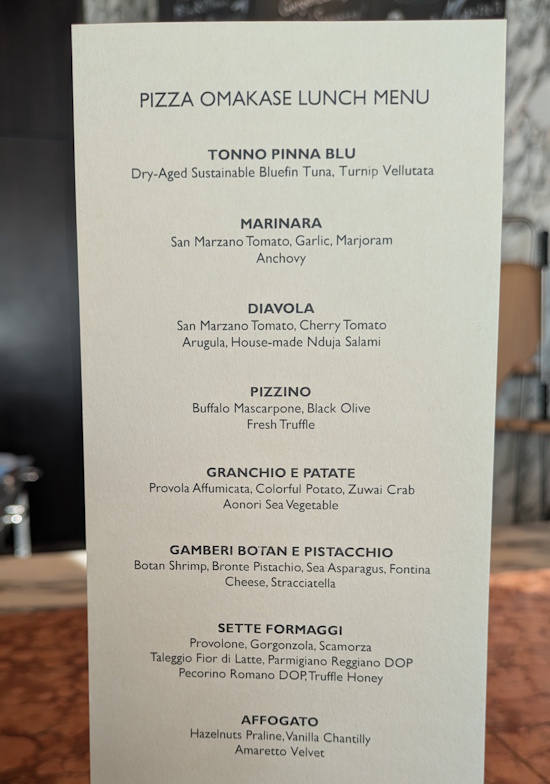
The menu changes several times a year, but here is the menu from my “tour:”
My deep thanks and appreciation to all of the thoughtful and masterfully talented people that make a pizza tour at Pizza Bar on 38th possible.
Bravo. Suberashi. Saiko. Kompeki. Oishkata.
For more Tokyo Pizza see:
— Truly excellent Neapolitan pizza at Pizza Marumo in Ebisu, Tokyo
— Pizza Studio Tamaki in Rippongi, Tokyo
— Sabasu Pizza in Akasaka, Tokyo
— Massimotavio Pizza in Suginami City, Tokyo
— Savoy Pizza Domi-LA in Asabujuban, in Minato City, Tokyo
— Bonta Italia pizza in Sarugakucho, Shibuya, Tokyo
— Pizzakaya in Minato City, Tokyo
— Devil Craft Pizza in Kanda, in Chuo City, and also the DevilCraft Gotanda, in Shinagawa, Tokyo
— Pinsa at Bonta Italia in Sarugakucho, Shibuya, Tokyo
— Pizza Strada in Azabujuban, Minato City, Tokyo
— Shibuya pizza at Kevelos, in Tokyo
— Frey’s Famous Pizza in Rippongi, Tokyo
— Seirinkan Pizza and Beatles music in Meguro, Tokyo
— The Komazawa Napoli Sta’ Ca” Pizza in Setagaya City, Tokyo
— Risto Pizza in Azabudai, Minato City, Tokyo
— Chicago-style pizza at Butcher Republic in Ebisu, Tokyo
Pizza Slices in Tokyo
— Rocco’s New York Style Pizza slices in Ojihoncho, Kita City, Tokyo
— High-quality gourmet pizza slices at Tonyz Pizza Slices in Koto City, Tokyo
— Pizza slices at Nim’s in Azabujuban, in Minato City, Tokyo
— Very mediocre pizza at Pizza Slice on Cat Street, in Shibuya, Tokyo