
Pizza Strada in Minato City, Tokyo
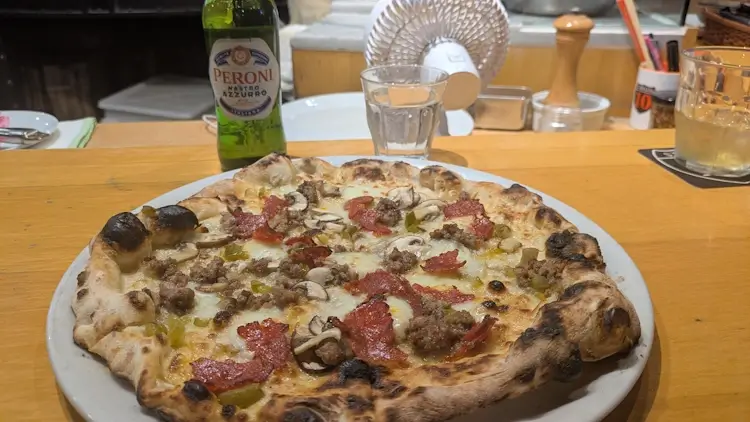
And here we go: As the latest addition to our list of pizza in Tokyo; we present our review of Pizza Strada in Azabujuban, in Minato City, Tokyo.
Is it tasty? Yes it is. For more about the orange cheddar, the orange volcano sauce, and the orange Italian coffee company – read on.
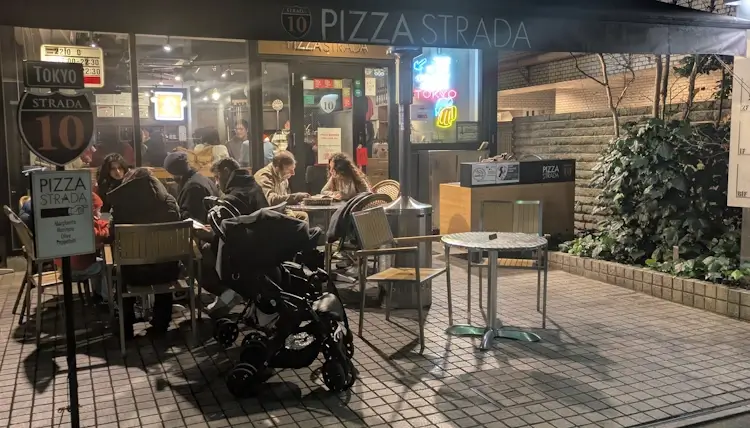
Minato City may be the epicenter of pizza in Tokyo; (not necessarily the best pizza, but) an intense concentration of some heavy hitters in Tokyo’s pizza scene. Pizza Strada stands shoulder to shoulder with Savoy Domi-La and Savoy Tomato and Cheese. Not too far away is PST Higashi-asabu. To the north, you have the most over-hyped pizza in Japan (which I am intentionally not mentioning), as well as 4Ps pizza (which I have yet to try). Why all these pizza restaurants in a few blocks? I don’t know. It’s just a hot part of town.
As for Pizza Strada – we think “strada” means “street” (in Italian). Out front of the shop, you’ll see some “road” signs, including a “Route 10” sign. What that #10 is all about, is also a mystery.
Where we are more certain is about the pizza. Take a look:
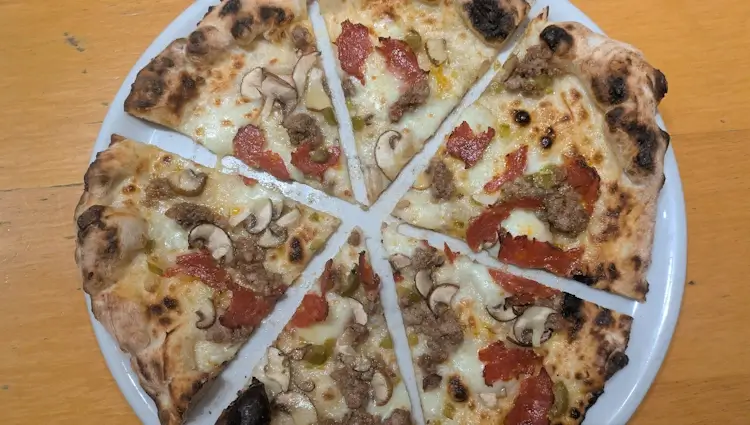
In our pictures, you can see Tokyo’s Pizza Strada makes a nice-looking, gourmet-quality pizza. A sophisticated experience, without needing a huge effort to get a reservation. For the record: It may not have been necessary, but I booked my reservation 11 days in advance.
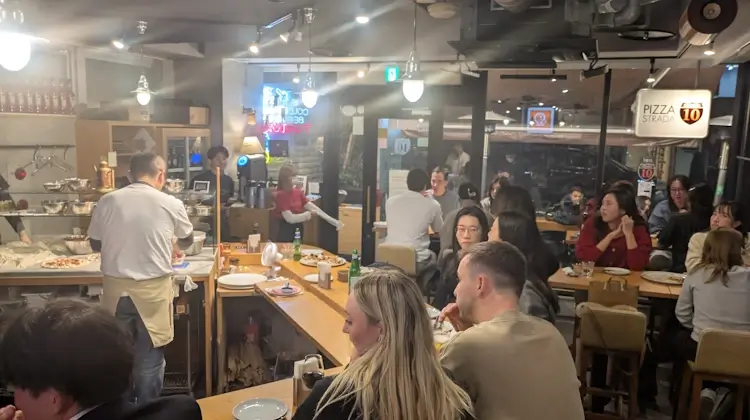
The interior of Tokyo’s Pizza Strada was comfortable, a little cluttered, but felt like a nice experience. You could take a date there and it would feel special.
As I arrived, jazz was playing overhead. I got the super-killer counter seat, staring into the maw of the oven. From where I sat, I could feel the heat on my face.
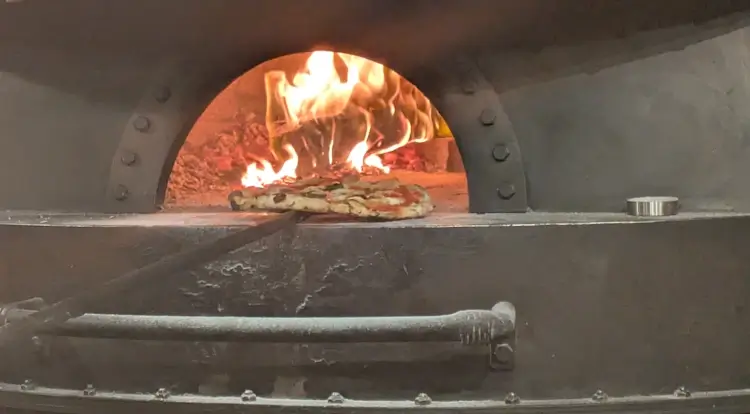
Pizza Strada had a full complement of staff; friendly, very attentive, but somewhat young and inexperienced.
My experience began with a young server who seemed a little overwhelmed. He was convinced the only way I could get a Maker’s Mark was as part of a pre-blended highball; which I know could not possibly be true, and wouldn’t order even if it was. Locked in stalemate on that topic, I demurred and choose a Japanese whiskey instead. Presumably straightened out by a coworker, he returned to my seat to say they did, indeed, have Maker’s in the bottle – so on the rocks would be fine, after all.
“I told you.” I’m not saying it was his first night… but whiskey on the rocks… doesn’t get much more simple than that.
As a hakujin in Japan, I feel like the staff I am interacting with are sometimes set out of balance by my perverse foreignness. That may have been the case on this night, but seems unlikely; Pizza Strada has a very international crowd, lots of foreign faces. A stray white guy shouldn’t rock the boat too much.
In possession of my whiskey rocks, I was excited, of course, to see the pizza menu.
Big menu: On the Pizza Tomato Page 1; 7 pizzas, including six different Margherita pizzas. On Pizza Tomato Page 2; eight more pizzas, including several more interesting varieties. Then the Cheese-base Pizzas; nine more, including a sauceless pepperoni (that sounded wonderful).
I wanted to start with an appetizer – just for you, the reader – so you could see a little more of the menu. I ordered the Assortment of Jamin Serrano & Salami.
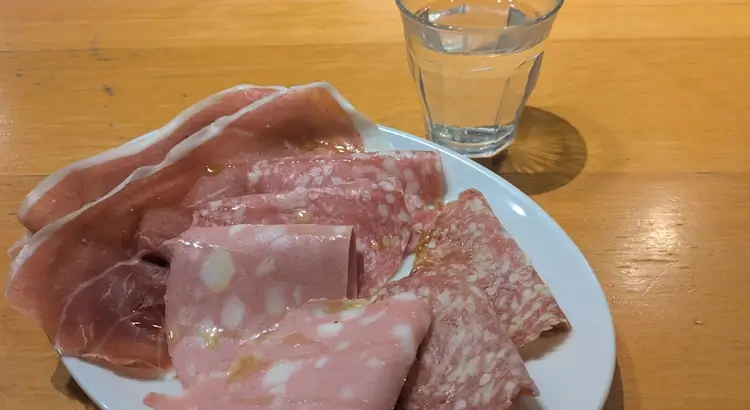
The Serrano ham (gamey and rich) had flavor that would build and build with each moment. The mortadella (almost creamy with fat) made me long for an Italian deli sandwich. Another salami with a very strong taste (must have been deer or some “alternative” meat).
Whiskey. Meat plate. I was off to a good start.
Back to the pizza, there were also some “Weekly Recommended” Pizzas.
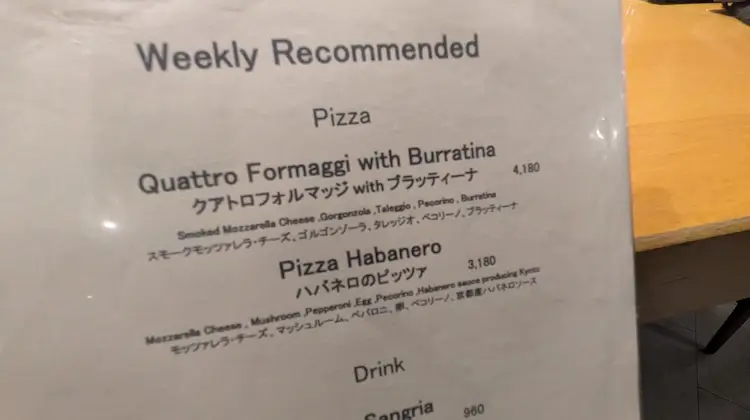
You should assume the “Weekly Recommended” Pizzas change often; perhaps… weekly. What you’ll see when you arrive will likely not be what I saw on my first visit. But as for me; it was the Four Cheese and the World’s Spiciest Pizzza.
While the Quattro Formaggi was not tempting (I can get a four cheese pizza – or an “eight cheese” pizza – anywhere in Japan). I was, however, briefly convinced I was ready for that Habanero spicy special.
Pizza Habanero: Mozzarella Cheese, Mushroom, Pepperoni, Egg, Pecorino, Habanero Sauce producing [sic] Kyoto.
— From the Weekly Recommend Menu at Pizza Strada
When I asked a server about that pizza, she said it was the “ichiban” spicy option. I know I am not really the guy that needs the spiciest thing in the whole universe, so I wisely tucked tail, and back down. “No, no. Now that I think about it…”
What kind of guy does in fact order the hottest pizza in Tokyo? While I was there, someone did order it. I’ll say more about that guy below.
Scrambling to choose something other than the Habanero, I briefly considered the Romana, but I remembered the sausage so I scoured the menu for that one.
Salsiccia Bianca Pizza: Mozzarella Cheese, Homemade Salsiccia, Pepperoni, Mushroom, Jalapeno.
— From the pizza menu at Pizza Strada
Not quite the Habanero, but with the inclusion of some jalapeno I completed my order with some of semblance of my masculine pride in tact.
While I did not order it, there was a Waygu Beef Pizza on the Tomato Pizza Page 2 that caught my eye – both on the menu, and as I watched it prepared in front of me.
Pizza Wagyu Beef: Minced Waygu, Mozzarella Cheese, Tomato Sauce, Red Cheddar, Red Onion, Mushroom, Jalapeno, Pecorino, and Pepper.
— From the Pizza Strada pizza menu
We have a picture here of the Waygu Beef Pizza just before it went into the oven.
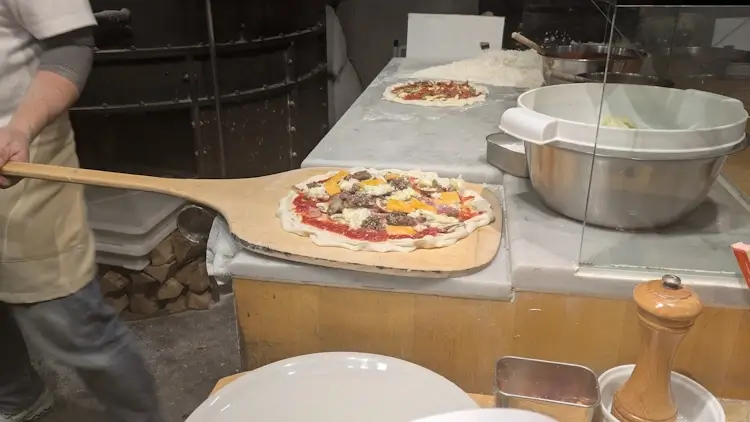
I took that particular picture, because cheddar is so rarely seen in a Napolitana pizza restaurant. And as you review the ingredients (above), you can see what it is; something close to “hamburger” pizza; beef, onions, and cheddar.
I think I’d like to try that one next time. Sounds amazing.
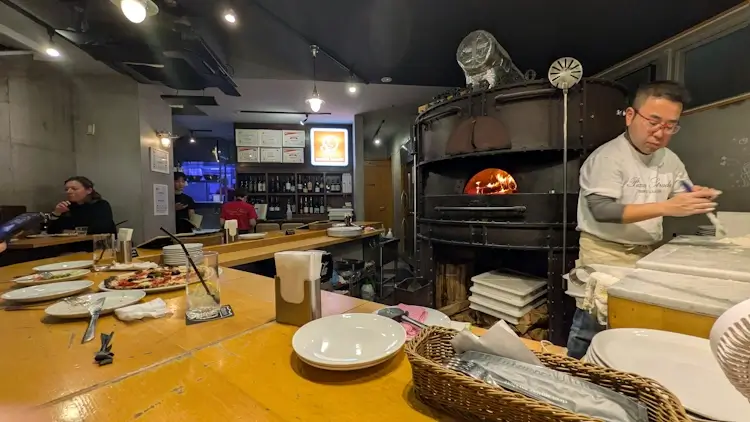
Sitting at the counter, with a crows-nest view of the pizza making process, I was having a good time. I watched the pizza master at his craft:
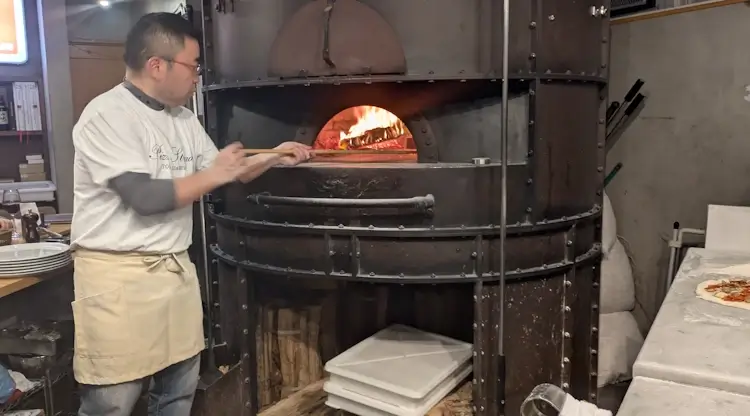
The pizzailo would begin each pizza first from the center of a wide, flat mound of flour, pushing the dough out from the center (with his right hand), turning it a little, pulling and pinching the other side back towards his body (with his left hand). At each turn, he’d give the outer rim of the dough a squeeze, crating an undulating up-and-down pattern, like a pie crust.
Before he’d put each pizza in the oven, he would take a big pinch of salt and sling a splash across the interior surface of the oven. I first saw this at Kevelos Pizza (Meijijingūmae). And Tokyo pizza fanatics know that the PST restaurants (PST Rippongi and Higashi-asabu) are famous for their (occasionally too generous) toss of the salt.
After each round of working with the pizza dough, the master’s hands were covered with flour. Completing each pizza, he would step away from his counter, and – clap – his hands. A meal in Pizza Strada is punctuated with this – clap – ritualistic de-flouring – clap – again and again. The pizza master at Da Massimo (in Sapporo) does that same clap. I like it.
After he puts in each batch of pizzas, he would take a scoop of wood chips and toss them into the fire, then switch peels and go back to adjusting each pizzas closer-farther versus the fire.
I watched him make my pizza. I watched him shovel it into the flames. My pizza – 59 seconds in the oven (yes, I timed it).
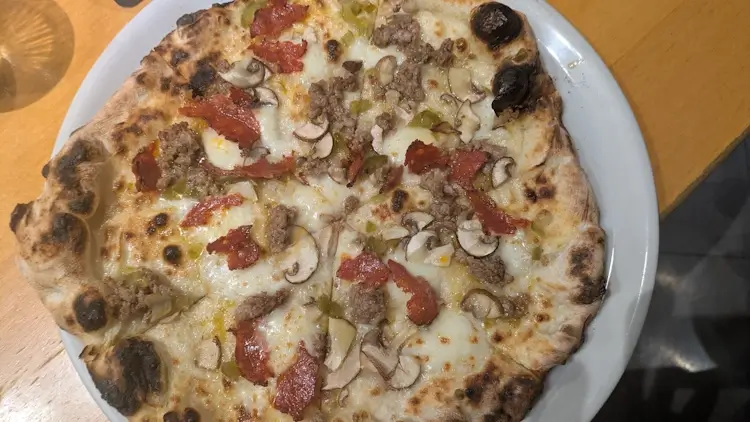
Just look at that pizza. Beautiful.
As my pizza arrived, a smell that reminded me of Mexican food was stimulating olfactory hallucinations of tacos. I assumed what I was smelling was the jalapenos, but I checked that idea: it was definitely the meat. At first I thought maybe it was something like chorizo that reminded me of Mexican culture. But then I realized – it was cumin.
While my pizza was a sausage (Salsiccia) pizza, this is not Italian sausage. There was none of classic fennel; this sausage had a Mexican-cumin taste. Combined with cheese, mushrooms, and jalapenos, it fit a taco-esque theme. Totally delicious.
And then, the crust; sturdy, with plenty of salt (like PST, although I think PST’s crust is better). A good crust, but playing a background role to the other tastes (the most prominent flavor coming from the burnt spots).
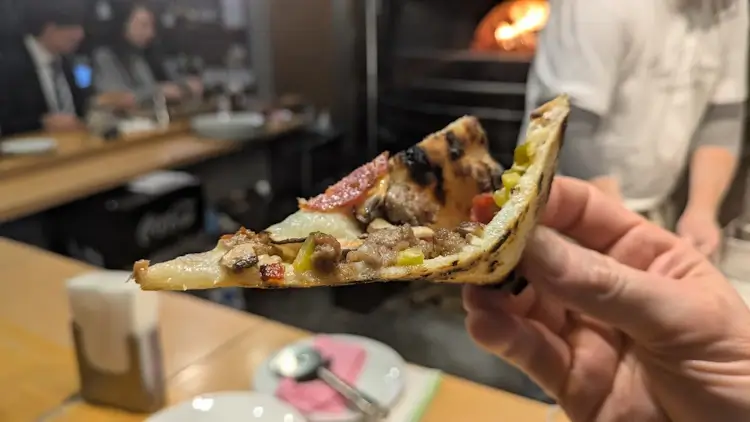
As you can tell by the Pizza Czar patented Pizza Test; yes, you can easily pick up a slice. Even loaded with toppings, this pizza somehow managed to remain light, and easy to pick up.
Good pizza. Recommended. And yeah, I do want to try that “hamburger” Wagyu Beef next time.
“But wait, wait… what about the Habanero?”
As I ate my “Mexican” pizza, alternating sips of my Maker’s and a Peroni, I watched him build the Habanero. As it is a cheese-base pizza, with mushroom (and an egg), it was mostly “white” as it was constructed. (For a flawless beauty of a “White Pizza,” check out Pizza Leon in Osaka.) The pizza took it’s one-minute turn in the oven, and then, before it was served, I watched the master put the spice on.
The “Kyoto” Habanero sauce was put on at the very end; an orange sauce (the same color as buffalo wings ), pouring it out of a bottle (like salad dressing), pooling up like a lake of radio-active fire on the surface.
That pizza looked terrifying. I was glad I did not order it, but someone did. I was eager to see whoever signed up for that assignment take their punishment. I watched, attentively, as that sociopathic pizza was delivered to a nice Australian guy just down the counter from me.
Waiting for him to take his first bite was like watching a horror movie; I waited, holding my breath, for the pizza to jump up and “tear a chainsaw” through the Aussie guy. I stared at him as he took his first taste; his eyes shot open like someone had stabbed him in the shower. He leaned over to his wife and he said, “It’s actually quite hot.” In that Aussie accent, prim and proper – funny! I was still staring, and grinning, and he looked over at me and we both laughed.
Hysterical.
I am so, so, so-so glad I did not order that pizza.
In retrospect; I know what Habanero pepper is. What was I thinking? It is ridiculous that I almost walked into that mess.
What is more ridiculous, though, is that they put the world’s spiciest murder pizza on the “recommended” list. It should be illegal to recommend that pizza to the average person. That pizza should more likely come with a warning. You should have to complete a series of trials, and earn a license, an be approved by a qualified expert… before they let you order that pizza.
A super hot, orange, Habanero pizza. What a terrible idea.
Speaking of orange: Did you notice the big, orange Bondolfi Boncaffe sign in the back of the shop? I did.
I had never seen that before, so I took a shot to help me remember to look it up. Before I had a chance to finish this review, I saw it again at Il Lupone Pizzeria (in Meguro City). What is that all about?
It turns out Bondolfi Boncaffe is an Italian coffee company. They made a play into Tokyo, opening several shops, but most seem to have closed down a few years back. It may be that Pizza Strada serves Bondolfi coffee, but I wouldn’t know… I was all about a whisky and a beer.
Good pizza. Good spot. I’d go back.
For more Tokyo Pizza see:
— Truly excellent Neapolitan pizza at Pizza Marumo in Ebisu, Tokyo
— Pizza Studio Tamaki in Rippongi, Tokyo
— Sabasu Pizza in Akasaka, Tokyo
— Our review of Pizza Bar on 38th in the Mandarin Oriental in Chuo City, Tokyo
— Massimotavio Pizza in Eifukucho, Tokyo
— Savoy Pizza Domi-LA in Asabujuban, in Minato City, Tokyo
— Pizzakaya in Minato City, Tokyo
— Devil Craft Pizza in Kanda, in Chuo City, and also the DevilCraft Gotanda, in Shinagawa, Tokyo
— Shibuya pizza at Kevelos, in Tokyo
— Frey’s Famous Pizza in Rippongi, Tokyo
— Bonta Italia pinsa in Shibuya, Tokyo
— Seirinkan Pizza and Beatles music in Meguro, Tokyo
— The Komazawa Napoli Sta’ Ca” Pizza in Setagaya City, Tokyo
— The Azabudai location of Risto Pizza in Tokyo
— Chicago-style pizza at Butcher Republic in Ebisu, Tokyo
Pizza Slices in Tokyo
— Rocco’s New York Style Pizza slices in Ojihoncho, Kita City, Tokyo
— High-quality gourmet pizza slices at Tonyz Pizza Slices in Koto City, Tokyo
— Pizza slices at Nim’s in Azabujuban, in Minato City, Tokyo
— Very mediocre pizza at Pizza Slice on Cat Street, in Shibuya, Tokyo