
Savoy Asabujuban “Domi-LA” Pizza, Tokyo
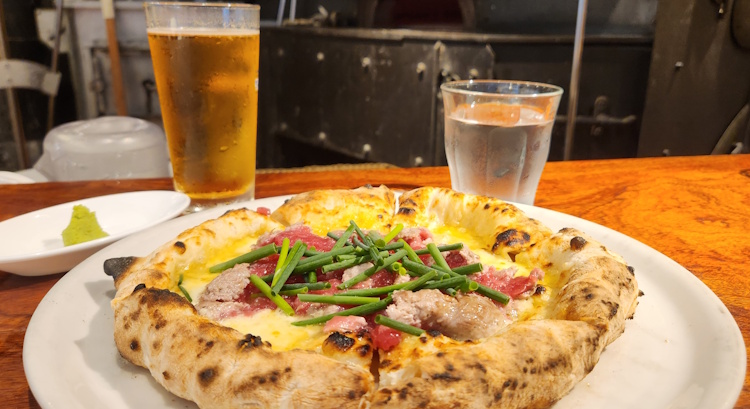
As part of our ongoing quest for exceptional pizza in Tokyo (and elsewhere in Japan, for that matter), we submit this review of our experience at the Asabujuban location of Savoy Pizza, in Tokyo, Japan.
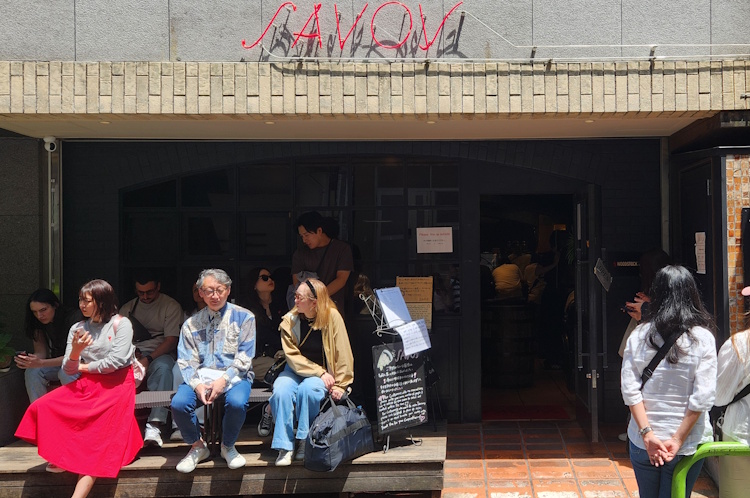
SAVOY 麻布十番本店 – which is also referred to as Savoy Domi-LA – is an important force in modern Neapolitan-style pizza in Tokyo (and beyond Tokyo – there is a Savoy pizza restaurant in Sapporo). Legend has it that the Savoy name begin with the guy that now runs the “steampunk” Seirinkan Pizza (across town in Meguro City). Savoy has at least two pizza shops in Tokyo; this one in Asabujuban (in Minato City), and the other Savoy Tomato and Cheese (a short walk away in the same neighborhood). This Asabujuban location is very close to the Asabu-Juban station.
High-end pizza in Tokyo happens on several levels. Some experiences can be very exclusive and require reservations weeks or months in advance (like Marumo Pizza in Ebisu, or the over-the-top Pizza Bar on 38th). Part of what makes Savoy one of the best pizza experiences in Tokyo is that it hits that sweet spot of a special meal without any ridiculous requirements to get a seat.
We arrived as they opened at 11:30 on a Sunday – a beautiful, warm spring day in Tokyo. Asabujuban Savoy Pizza was already operating with a full house, but there was no line. Despite Savoy’s extensive reputation, being able to walk-in (at least some of the time) makes Savoy accessible and a better option than some of the other “impossible to get into” places.
Pizza you can eat tastes better than pizza you cannot (when you can’t get a seat).
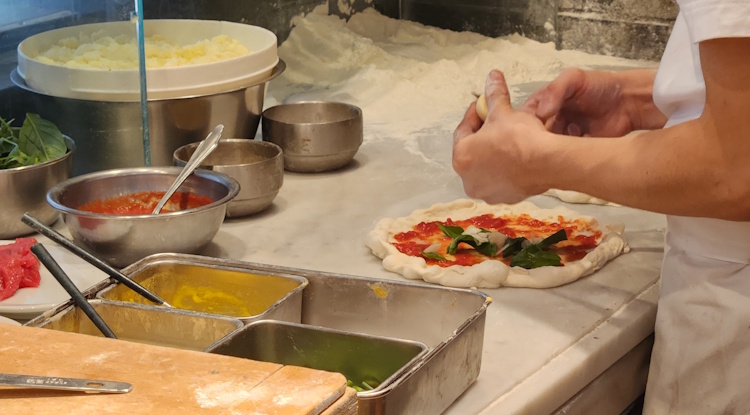
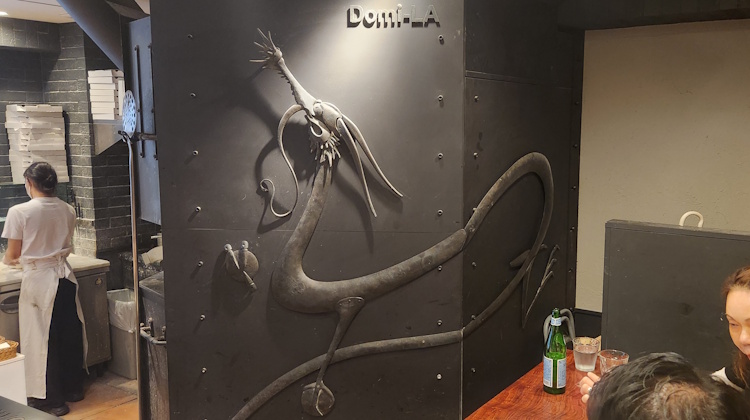
In our case, not only did we get a seat, but we were at the counter, staring at the pizza “senmonka” (on our left) and into the mouth of the oven (on our right). It was just luck, but that is exactly the seat I would have asked for if I could have had anything I wanted.
In my role as the Official Hakujin Pizza Czar of Japan, I have dutifully eaten at so, so many Japanese Napoletana pizza places. While that style might be considered “special” in some places, it is basically generic in Japan; every pizza maker in this country wants to make a margherita with a thin crust. “Wood fired pizza” – in my arrogant opinion – is not what makes pizza special, and these pizzas are especially un-special in Japan. But with that said…
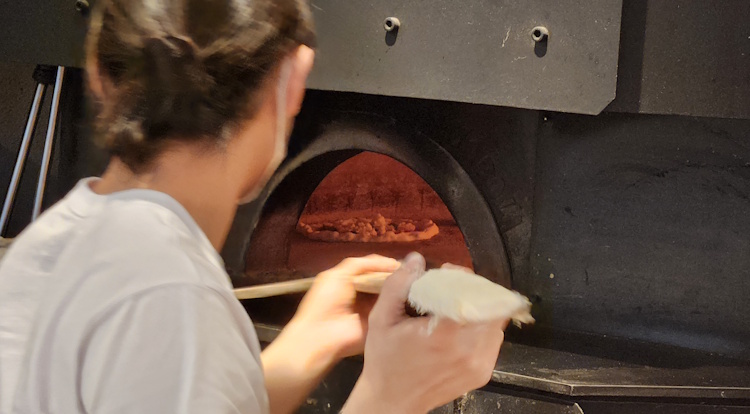
From these seats, we got to see the craft of pizza in progress. The making of the pizza is beautiful to watch, and this was a particularly good view.
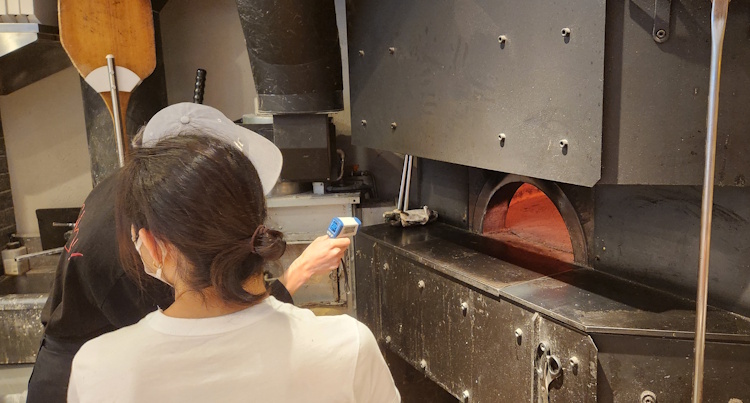
We even had the opportunity to witness the pizza masters using little blue guns that can somehow read the temperature of the oven. From our seats we saw: 477 °C, 506 °C, 502 °C. That is cool.
Sitting at the counter, it was fun to be at Savoy. Stylish. Good crowd. That fantastic smell of pizza out of the oven. And that is the point, of course.
The pizza; let’s get to it.
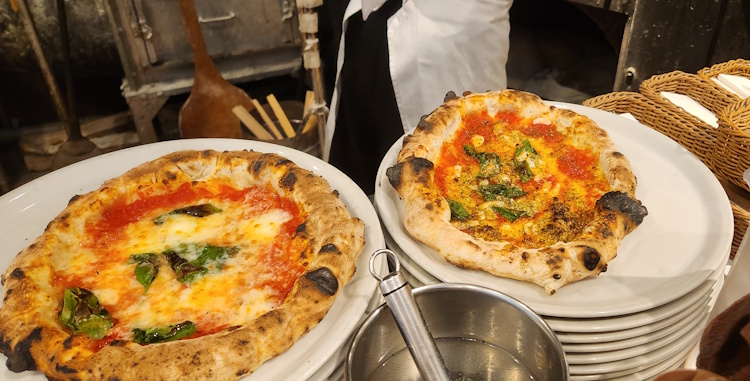
There are a number of pizza spots in Tokyo that seem to almost pride themselves on having a small menu. In the case of Tokyo’s Savoy Asabujuban, their list of pizzas is fairly extensive.
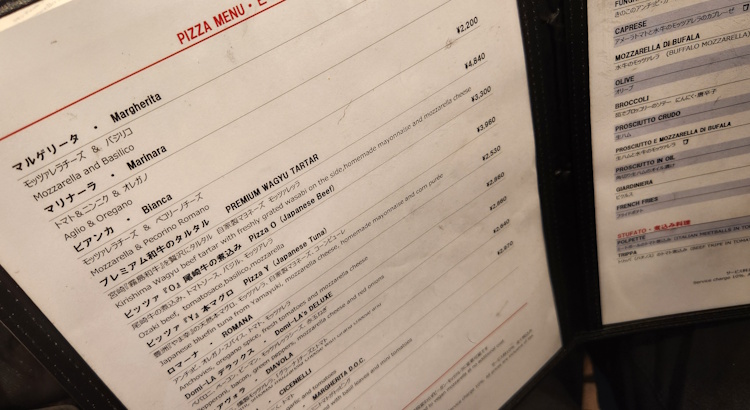
A quick, lazy count as I write this article: I see 10+ pizzas on the menu. Savoy serves a many-of-a-kind Margherita Pizza, and they are renowned for their specialty pizzas.
What caught my eye that day as I made my order: I had to try the Bluefin Tuna Pizza at Savoy (what they call Pizza “Y”). And then, the idea of Japanese Beef Pizza (known as Pizza “O”) was intriguing as well.
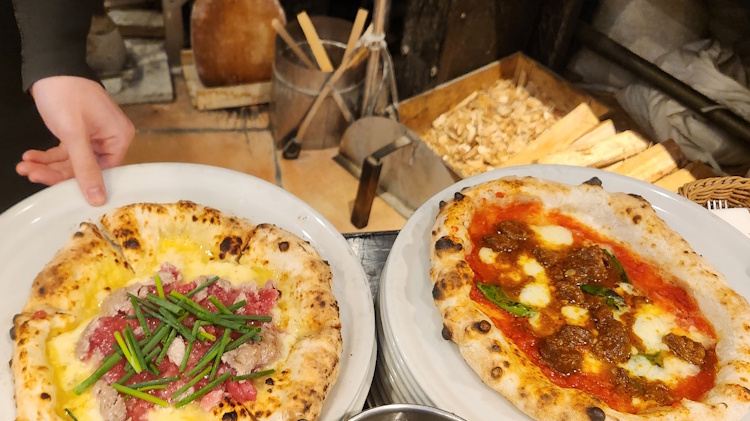
Based on what I had heard of Savoy Asabujuban, I was committed to trying the tuna pizza before I even walked in the door. However, when I saw that this particular pizza comes on a mayonnaise base (the Japanese will put mayonnaise on everything, if you let them), I hesitated (briefly); mayo on a pizza may sound good to a local, but sounds terrible to me.
The description reads:
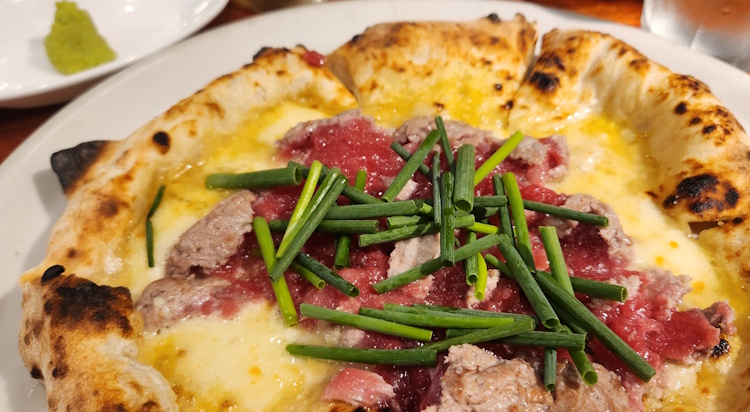
Bluefin Tuna Pizza: Japanese Bluefin Tuna from Yamayuki, Mozzarella Cheese, Homemade Mayonnaise, Corn Puree.
— From the pizza menu at Savoy Asabujuban
I don’t know that I would order it again, but it was in fact a good pizza. The execution takes both the mayo and the tuna in the right direction. In this case, the mayonnaise is part of a puree done with corn, and is subtle enough to not be oily or to overwhelm the more important flavors. For a more traditional (but less successful) tuna pizza, check out this version at Osteria Salvatore Sapporo (it was a pasty, bland tuna pizza with crunchy onions).
At Savoy, the tuna is surprising in that is starts out as a big pile in the center of the pizza as it goes into the oven. I have heard other Savoy-lovers describe the tuna as “seared” and that isn’t quite right.
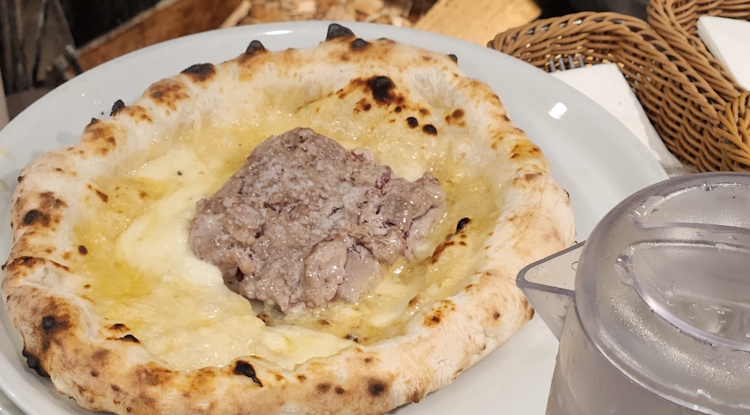
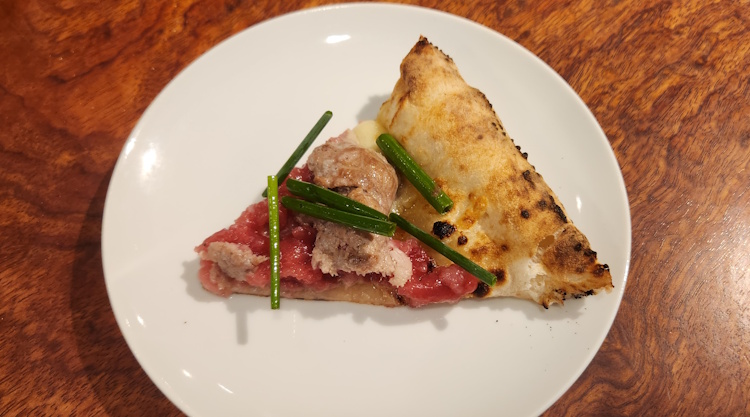
It goes into the fire a sushi-red, and is blasted by the heat for about a minute. As it comes out, it’s a pretty unattractive grey. They then break up the pile, and the bright red tuna color comes back out into the presentation. In the end, it is salty, rare, soft tuna. They then sprinkle on some thin, green onion sections, and the pizza is transformed into something intriguing and beautiful. For my tastes, it’s a “novelty” pizza, but it’s very well put together, and a good experience.
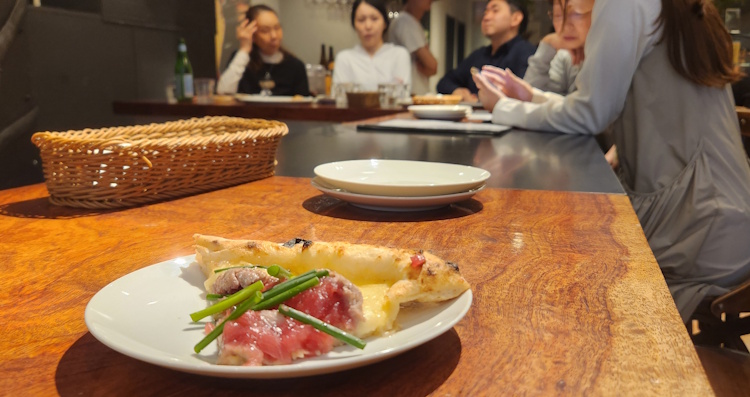
The dough, the pizza crust, the cornicione (as I’ve learned to say) is as good as any other part of the pizza, maybe more so; they serve an excellent crust at Savoy, in terms of flavor. Not the best in Tokyo, but very good.
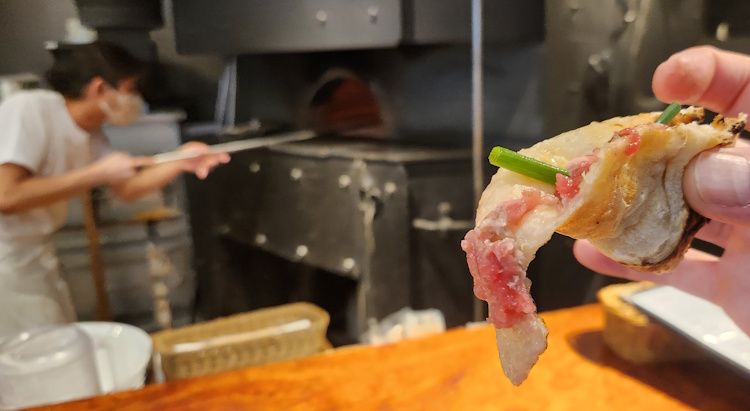
Puffy and beautiful on the edges, it is a very thin crust in the center. Their crust failed my “pizza test,” you cannot pick it up; a “knife-and-fork pizza” it is. My recommendation; use the crust to kind of pinch the tuna, pick it up, and get it where it needs to go.
Our Japanese Beef Pizza at Savoy was also good, but not as successful as the tuna.
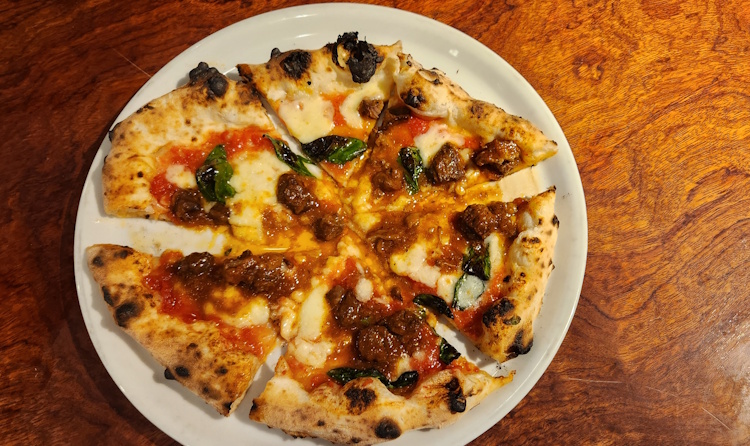
The beef is less like steak, and more like stew; little chunks of beef stew meat (perhaps braised in a tomato sauce, maybe with a strong-but-tasty onion component?), applied to the pizza and then run through 60 seconds or so in the oven. Good flavor, but as Savoy has a barely-functional crust, adding stew to the mix made for a very sloppy pizza. The stew flavor overwhelms the natural taste of the beef (which is probably high-quality but hardly matters in all that sauce). It was good, but not something I’d recommended. Definitely knife and fork pizza.
If I went back – and I would, gladly – I’d want to try the more traditional Domi-LA Deluxe Pizza: Pepperoni, Bacon, Green Peppers, Mozzarella, Red Onion. That sounds great, actually, and I’d bet it’s a better pizza than the more showy headliners on the menu.
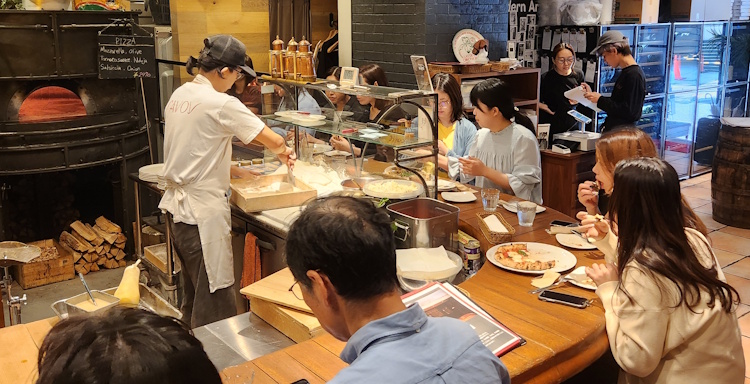
Savory operates two separate pizza ovens – one by the front door and another in the middle of the house – as well as a separate, third kitchen in the back. All of that cooking capacity, as well as the size of the shop, might explain why you can get in and out without a reservation. Having two pizza ovens means the “pizza-per-hour” (PPH) capacity is probably quite high.
And beyond the pizza (if you’re interested), they have more to offer on the menu:
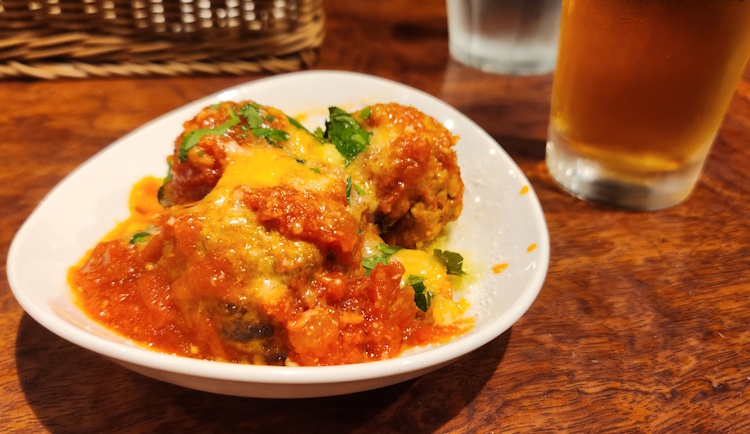
We also ordered the meatballs – Polpette. Three just-cooked meatballs, a red sauce, with plenty of garlic. The meatballs were really excellent, and helped curb the cravings as we waited for our order to come up.
We ordered the two pizzas (plus the meatballs) and couldn’t finish the meal.
These are heavy, rich pizzas. Napoletana pizzas come in so many different iterations, but there is a school of these pizzas that leave you feeling full, and a bit decadent. There is a feeling I get with some very high-end pizza, maybe it is the really high-fat content… leaving me a little over-satisfied. I can remember a similar feeling after my pizzas at Sabasu in Akasaka (and also at Dal Donnaiolo in Osaka). It’s a good thing – I mean that – it’s just, “a lot.”
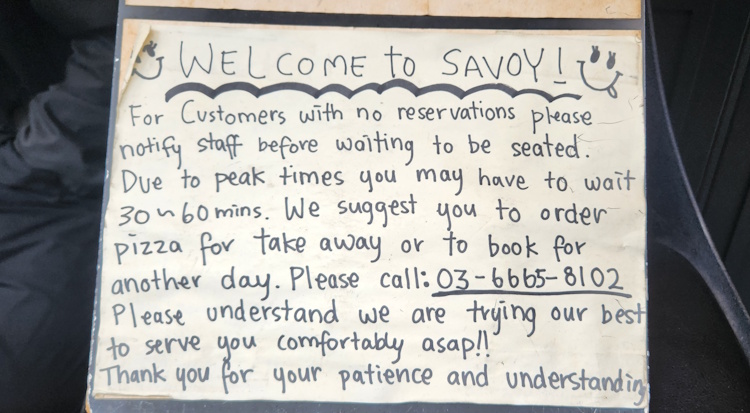
On the day we were here, seats would open next to us at the counter as we had our lunch. There were maybe five people waiting outside when we left, but at least on that day – with a short wait it’d be no trouble to get a table, even on a nice Sunday during the lunch hour.
Overall, Savoy provides a hip, high-quality experience. Not exclusive (who cares), but delicious and memorable. It feels great to be there.
After lunch, as we strolled back along the brief walk to the station, we came across a local American-style baked goods purveyor called Hudson Market Bakery. I may have been full, but it seemed I was not too full for a chocolate brownie to wash down all that savory Savoy.
For those of you that get around Japan, the Sapporo Savoy Pizza (in Hokkaido) is open for business, as well.
For more Tokyo Pizza see:
— Pizza Marumo in Ebisu, Tokyo
— Tokyo’s Pizza Bar on 38th at the Mandarin Hotel in Chuo-ku, Tokyo
— Neapolitan-style pizza at Massimotavio Pizza in Suginami City, Tokyo
— Pizza Studio Tamaki Rippongi, in Minato City, Tokyo
— Bonta Italia in Shibuya, Tokyo
— Sabasu Pizza in Akasaka, Tokyo
— Pizzakaya “California Gourmet Pizza” in Rippongi, Tokyo
— Devil Craft Pizza in Kanda, in Chuo City, and more deep-dish pizza at DevilCraft Gotanda, in Shinagawa,Tokyo
— Pizza Strada in Azabujuban, Minato City, Tokyo
— Shibuya pizza at Kevelos, in Tokyo
— Frey’s Famous Pizza in Rippongi, Tokyo
— Seirinkan Neapolitan Pizza in Meguro, Tokyo
— Pizzeria da Peppe Napoli Sta’ Ca” in Setagaya City, Tokyo
— Butcher Republic pizza restaurant in Ebisu, Tokyo
— Tokyo’s Risto Pizza in Azabudai, Minato City, Tokyo
Pizza Slices in Tokyo
— Rocco’s Pizza in Ojihoncho, Kita City, Tokyo
— Pizza slices at Nim’s in Azabujuban, in Minato City, Tokyo
— NYC-style pizza slices at New York Pizza Tonyz (Saturdays and Sundays only) in Koto City, Tokyo
— I do not recommend Pizza Slice in Shibuya on Cat Street